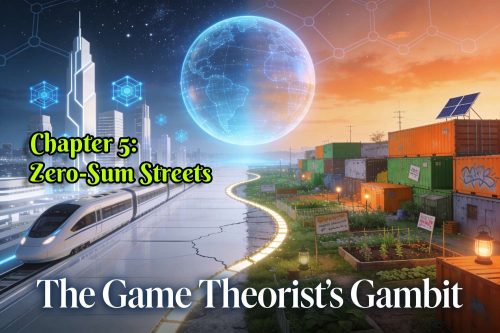
A neutral café on the border between New Athens Prime and the Feral District. Two days after the Schelling Point revolt.
The café had no name. Or rather, it had too many names—someone had painted The Broken Token over the door in faded gold, but a hand-lettered sign beneath it read Free Coffee for Kindness and another, scrawled on a napkin taped to the window, said Elias Was Here. The old hoarder had apparently ventured out for the first time in years.
Ava and Kai sat at a corner table, their third cups of coffee gone cold between them. Spread across the scarred wooden surface were printouts—old-fashioned paper, because the café’s network connection was spotty—covered in equations, token flow diagrams, and increasingly frustrated scribbles.
Ava had been trying for two hours to design a fair auction.
“The problem is the starting distribution,” she said, tapping a page covered in密密麻麻的 numbers. “A flat airdrop of 1,000 tokens per person sounds equal, but it’s not. The residents of the Feral District have no other assets. A Prime citizen with 10,000 tokens in savings can bid far above them on every property.”
“So fix it,” Kai said. He was not being sarcastic. He was genuinely asking.
“I’ve been trying.” She pulled out a fresh sheet. “Watch this.”
She drew a vertical line down the middle. On the left she wrote Current Residents. On the right, External Bidders.
“Suppose we add a ‘community loyalty multiplier.’ Every year a resident has lived in the district, their bid gets multiplied by 1.05. So someone who’s been here for twenty years gets a 2.0 multiplier—their 1,000 tokens act like 2,000.”
Kai leaned forward. “That helps.”
“It helps, but it’s not enough. A Prime citizen with 10,000 tokens can still outbid a twenty-year resident with a 2.0 multiplier, because 10,000 is still larger than 2,000.” She drew another line. “So we also add a ‘social cohesion bonus.’ If a group of neighbors bid together—say, everyone on one block—their combined multiplier increases by another 1.2 factor. That encourages people to stay together.”
“Now we’re talking.”
Ava smiled—a rare, unguarded smile. “And finally, we cap external bids. No one who hasn’t lived in the district for at least five years can bid more than 70% of their token balance. That protects against wealthy outsiders buying up everything.”
She sat back, proud of her work. The model was elegant. It balanced fairness with efficiency, rewarded loyalty without completely locking out new residents, and created incentives for collective bidding. The Oracle would probably accept it—it was mathematically sound and improved overall utility compared to the Warden’s flat auction.
Kai looked at the equations for a long time. Then he picked up a pen and did something that made Ava’s stomach drop.
He ran the numbers.
Not the abstract variables—the real numbers. The actual token balances of actual people. He had pulled the data from his district’s public records (what little existed) and from Ava’s own high-resolution models of Prime’s distribution. He wrote them out, line by line, in his messy, slanted handwriting.
Average Prime bidder balance: 8,400 tokens.
Average Feral resident balance: 1,200 tokens (including the airdrop).
*Maximum loyalty multiplier (20+ years): 2.0.*
Maximum cohesion bonus: 1.2.
*Effective Feral bid capacity: 1,200 × 2.0 × 1.2 = 2,880 tokens.*
*Prime bidder with 70% cap: 8,400 × 0.7 = 5,880 tokens.*
He circled the two numbers. 2,880 vs. 5,880. Then he wrote a single word underneath: ZERO-SUM.
Ava stared at the page.
“It’s still not enough,” she whispered.
“It’s not about enough. It’s about structure. Look at where the tokens come from.” Kai drew a large circle around the entire auction system. “The Warden is redistributing property rights. But she’s not creating new value. Every token a Feral resident saves on their bid is a token the city loses in auction revenue. Every property a resident keeps is a property someone else doesn’t get. Your multipliers and bonuses are just moving the same pie around.”
“That’s not—” Ava stopped. He was right.
She had been so focused on making the auction fairer that she had forgotten to ask whether the auction itself was the right tool. The Warden’s game was zero-sum by design. The total amount of value in the system—measured in tokens and property—remained constant. Any gain for the Feral District was a loss for the city’s treasury. Any gain for Prime bidders was a loss for the residents.
“There’s no growth,” she said slowly. “No creation. Just transfer.”
Kai nodded. “Your models assume scarcity. They always do. Every game you’ve ever designed starts with a fixed pool of resources and tries to divide it optimally. But the Feral District doesn’t think that way. We don’t have a pie. We have a garden.”
Ava looked up. “A garden grows.”
“A garden grows. You put seeds in the ground, you add water and sun and care, and you get more food than you started with. That’s not zero-sum. That’s positive-sum. Everyone can win.”
“But that’s not—” She struggled to find the words. “That’s not how token economics works. Tokens represent real resources. You can’t create tokens from nothing. If the city gives you a token, it has to take a token from somewhere else. The ledger has to balance.”
“The ledger balances because the ledger is a lie.”
Ava blinked. “What?”
Kai leaned forward. “The Oracle’s ledger says the Feral District has zero economic activity. But we grow food. We build furniture. We teach each other skills. We take care of each other’s children. All of that has value. Real value. But the Oracle doesn’t see it because it doesn’t fit into a transaction.”
“That’s not the same as token creation—”
“It is, though. You just don’t have the right units.” He picked up a carrot from a bowl on the table—the café offered free vegetables from the garden—and held it up. “This carrot has value. If I give it to you, we’re both better off. You get food. I get the satisfaction of sharing. No tokens changed hands. But the total value in the system increased. That’s positive-sum. That’s creation.”
Ava took the carrot. She turned it over in her hands. It was knobby and imperfect, nothing like the laser-sorted produce in Prime’s markets. But it smelled like earth and sweetness.
“Your system doesn’t have a category for that,” Kai said quietly. “So your system thinks it doesn’t exist. And because it doesn’t exist, your models say the only way to help my district is to take resources from somewhere else. That’s why every solution you design is zero-sum. You’ve been optimizing for scarcity because you’ve never been taught to see abundance.”
Ava felt something crack inside her—not painfully, but like ice breaking on a river. A thaw.
She had spent her whole life learning to optimize. To allocate. To find the Nash Equilibrium, the dominant strategy, the efficient outcome. She had never once asked whether the game itself was the right game.
“What if altruism isn’t irrational?” she said, half to herself. “What if it’s just… long-term thinking that the Oracle hasn’t coded yet?”
Kai put down his pen. “Now you’re asking the right question.”
They walked out of the café into the late afternoon light. The streets of the border zone were quiet—most people were still recovering from the standoff at the garden. But a few Feral District residents were out, rebuilding a collapsed retaining wall, sharing tools, laughing about something.
Ava watched them. Her wristband buzzed with a new notification—a routine request from the Oracle to optimize her daily schedule. She dismissed it without reading.
“The Warden is going to announce the auction parameters tomorrow,” she said. “If we don’t have an alternative by then, she’ll proceed.”
“We have an alternative,” Kai said. “But you’re not going to like it.”
“Try me.”
He stopped walking. They were standing at the edge of the community garden, where the hand-holding had happened. The grapevines were heavy with fruit.
“We refuse to participate,” he said. “Not just the auction. The entire token economy. We stop treating tokens as real. We build our own systems—barter, gift, mutual aid. We make the Oracle’s ledger irrelevant.”
Ava’s first instinct was to argue. That was economic suicide. Without tokens, the Feral District couldn’t access Prime’s infrastructure—the transit, the medical system, the schools. They would be cut off, isolated, reduced to a pre-industrial enclave.
But then she looked at the garden. At the people laughing. At the child who had just bitten into a carrot.
“You already do that,” she said. “You’ve been doing it all along. The Oracle’s ledger says you have nothing. But you have each other.”
Kai nodded. “The problem is that ‘each other’ isn’t enough when the Warden sends drones. We need resources. We need infrastructure. We need a way to participate in the city without being consumed by it.”
“So you need a hybrid system. Something that combines the efficiency of tokens with the trust of the garden.”
“That’s what I’ve been trying to tell you since you showed me the recycling chute.”
Ava stood very still. The pieces were falling into place—not as a solution yet, but as the shape of a solution. A game that wasn’t zero-sum. A system that rewarded cooperation over extraction. A ledger that counted kindness as currency.
“I need to go back to my lab,” she said. “There’s a smart contract template I’ve been working on. It was rejected by the Oracle last year for being ‘too speculative.’ But maybe—”
“Maybe it’s exactly what we need.”
She looked at him. He was watching her with an expression she hadn’t seen before—not skepticism, not hope, but something in between. Curiosity. Respect.
“I’ll walk you to the border,” he said.
They walked in silence. The sun was setting, painting the sky in shades of orange and pink that the Oracle’s weather algorithms had not predicted. Sometimes, Ava thought, the best things were the ones you couldn’t optimize.
At the border—the crooked plywood sign, Welcome Home. Be Weird—Kai stopped.
“One more thing,” he said. “Your model. The one with the multipliers and the bonuses. It was beautiful. Really.”
“But?”
“But beautiful math can still serve a broken game.” He reached out and touched her wristband—not aggressively, but gently, like a teacher correcting a student’s hand. “The question isn’t how to divide the pie more fairly. The question is why we’re fighting over pie when we could be baking bread.”
Ava looked down at her wristband. The silver band glowed softly, tracking her heart rate, her location, her token balance. It had been her companion since childhood. It had taught her everything she knew about rationality.
It had never taught her how to bake bread.
“I’ll see you tomorrow,” she said.
“Tomorrow,” Kai agreed.
She crossed the border into Prime. The polymer walkways were smooth beneath her feet. The LED strips glowed to life as she passed. A drone overhead hummed a soft, efficient tune.
But for the first time, the perfection of it all felt less like a triumph and more like a cage.
She touched her wristband.
“Oracle,” she said quietly, “what is the utility function for love?”
The Oracle did not answer. It had no variable for that.
Ava smiled—a small, sad, determined smile.
Time to write one, she thought.
Table of contents:
Introduction
Prologue: The Prisoner’s Dilemma of New Athens
Chapter 1: The Incentive Architecture
Chapter 2: The Nash Equilibrium Slum
Chapter 3: A Suboptimal Player
Chapter 4: The Schelling Point Revolt
Chapter 5: Zero-Sum Streets
Chapter 6: The Byzantine Neighborhood <<<<<< NEXT
Chapter 7: Iterated Play
Chapter 8: The Cooperative Airdrop
Chapter 9: A Positive-Sum City
