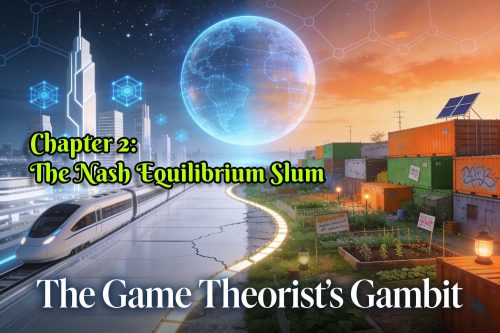
The border between New Athens Prime and the Feral District was not a wall. New Athens did not build walls; walls were inefficient and signaled distrust, which was bad for social utility. Instead, the border was a gradient—a slow decay of order into something messier, something unclassified.
It began with the paths.
On Ava’s side, the walkways were smooth polymer, exactly 1.2 meters wide, with embedded LED strips that glowed softly at night. Every fifty meters, a sensor node recorded foot traffic and adjusted the ambient lighting for optimal safety-to-energy ratios. The trees were spaced at precise intervals—six meters apart, alternating species to minimize disease spread.
Then, without warning, the polymer gave way to cracked asphalt. The LED strips stopped. The trees became irregular—clustered here, sparse there, some leaning at angles no arborist would approve. A rusted signpost leaned into the path, its surface covered in layers of peeling paint and, beneath them, the ghost of an old street name no one remembered.
And then there was the real sign.
Ava stopped walking when she saw it. On her side, a sleek digital display mounted on a chrome pole read: Optimal Path Ahead. Stay on designated walkways for maximum efficiency.
Three meters ahead, on the Feral side, a crooked sheet of plywood had been nailed to a telephone pole. Hand-painted letters in bright orange read: Welcome Home. Be Weird.
Kai stood beneath the sign, his arms crossed, watching her read it.
“Who painted that?” Ava asked.
“Everyone,” he said. “The letters fade, so someone repaints them. No one remembers who started it. It’s just… there.”
“That’s not sustainable. There’s no ownership, no accountability, no incentive for maintenance.”
Kai smiled. It was the first genuine smile she had seen from him—not ironic, not defensive. Just warm. “And yet it’s been there for eleven years. Longer than your LED strips, probably. Those things burn out every eighteen months.”
Ava opened her mouth to argue about mean time between failures and the Oracle’s predictive replacement algorithm. Then she closed it. He wasn’t trying to win an argument. He was trying to show her something.
“Okay,” she said. “Show me your district.”
The Feral District was not what she had expected.
She had prepared herself for squalor—for the kind of poverty the old textbooks described before the founding. Trash in the streets. Broken windows. People huddled in doorways. The Oracle’s data suggested as much: low token balances, high rates of uncooperative behavior, a Nash Equilibrium classified as a poverty trap.
But the streets were not filthy. They were just… unmanaged.
A community garden spilled across a vacant lot, bounded by a low fence made of reclaimed pallets. Tomato vines climbed bamboo stakes. Lettuce grew in old bathtubs. A scarecrow wore a faded yellow raincoat and a straw hat. No QR codes. No sensor nodes. Just dirt, seeds, and hands.
Children ran barefoot on a patch of grass that had not been measured in centimeters. They were playing a game that involved a deflated ball and a lot of shouting. Their wristbands—the ones who wore them—were dark. No active prompts. No token rewards. They were playing because it was fun.
A woman sat on a stoop, mending a pair of trousers with a needle and thread. Not a smart fabric repair station. Just thread. Her hands moved with practiced efficiency, the same motion repeated for what looked like decades.
“This is…” Ava searched for the word. “Not what I expected.”
“You expected a disaster,” Kai said. Not accusing. Just stating.
“I expected the data to be accurate.”
“Data is accurate. For what it measures.” He gestured at the garden. “The Oracle measures token transactions. We don’t use tokens. So to the Oracle, we’re doing nothing. Zero economic activity. Zero cooperation. Zero trust.”
“But that’s not true. You’re growing food. You’re sharing tools. That woman is repairing clothes instead of buying new ones—that’s resource conservation. That’s valuable.”
“To you. Not to the Oracle. The Oracle doesn’t have a category for ‘mending.’ It has a category for ‘textile recycling’—drop your old clothes in a chute, earn 0.2 tokens. But sitting on a stoop with a needle and thread? Invisible.”
Ava looked at her wristband. She pulled up the public dashboard for the Feral District. The numbers blinked at her in crisp, unfriendly red:
*Trust Index: 2/100*
Cooperation Rate: 11%
Nash Equilibrium Classification: Poverty & Hoarding (Stable, Suboptimal)
Recommended Action: Incentive restructuring or phased relocation.
“That’s what the Oracle sees,” Kai said, reading over her shoulder. “A bunch of irrational hoarders trapped in a bad equilibrium. Every person for themselves. No trust. No future.”
“But that’s not what I’m seeing.”
“So stop looking at your wristband. Look at the street.”
Ava looked.
An old man was sweeping the sidewalk in front of his house. Not because a sensor had detected debris and issued a maintenance request. Just because it was morning, and the sidewalk was dusty, and he wanted it clean. A young woman passed by carrying a basket of eggs. She handed two to the old man. He nodded. No tokens changed hands.
“That’s a transaction,” Ava said. “A gift. The Oracle doesn’t record it.”
“The Oracle doesn’t see it. So the Oracle thinks nothing happened.”
Ava felt a small, cold discomfort in her chest. She had spent her whole life trusting the Oracle’s models. They were elegant. They were mathematical. They were supposed to be complete.
But here was a whole neighborhood running on a different kind of math. Slower. Messier. Invisible.
Kai turned down a narrow side street. The houses here were older—repurposed shipping containers stacked two high, their corrugated walls painted in murals of animals and stars. Some had small solar panels on their roofs, jury-rigged and mismatched. Others had clotheslines strung between them, sheets flapping in the breeze.
“Where are the sensors?” Ava asked. “The Oracle must have some presence here. The annexation agreement required infrastructure installation.”
“The infrastructure is there.” Kai pointed to a utility pole. Bolted to it was a standard Oracle sensor node—the same model used throughout New Athens. But its lens was covered with duct tape. Its antenna had been bent sideways.
“They disabled it,” Ava said, horrified.
“They ignored it. There’s a difference. The sensor tries to collect data. We just don’t participate. No one scans their wristband at the node, so the node reports null values. The Oracle flags it as ‘low engagement’ and moves on.”
“But why? The data could help the Oracle design better games for you. It could optimize—”
“It could optimize us into extinction,” Kai said quietly. “Your games assume we have something we don’t have.”
“What?”
“Trust.”
They had stopped in front of a house that was different from the others. It was not painted. Its windows were barred with heavy iron grilles, not the decorative kind but the functional kind—the kind that said keep out. The door was triple-locked: a deadbolt, a chain, and a heavy sliding bar. Around the perimeter, a chain-link fence topped with razor wire enclosed a yard filled with—Ava squinted—canned goods. Hundreds of cans. Stacked in pyramids, covered with tarps, weighed down with bricks.
“Who lives here?” she whispered.
Kai’s voice was soft. “His name is Elias. He’s been here since before the annexation. When the Oracle first arrived, it offered token rewards for sharing resources. Elias had a vegetable garden. He shared with neighbors. He earned tokens. For a while, it worked.”
“What happened?”
“The Oracle changed the parameters. It does that—adjusts rewards to optimize social utility. One month, sharing vegetables was worth 0.3 tokens per kilogram. The next month, the Oracle decided that vegetable sharing was ‘less valuable than previously estimated’ and dropped the reward to 0.05. Elias kept sharing anyway—he didn’t care about the tokens. But then the Oracle introduced a penalty for ‘inefficient resource distribution.’ If you shared vegetables and the recipient didn’t use them within 48 hours, the system penalized you for waste. Elias couldn’t control what people did with the vegetables after he gave them. He got penalized. His balance dropped.”
Ava knew this logic. It was standard anti-hoarding protocol. The Oracle assumed rational actors who would only request what they needed. But if someone requested vegetables and then let them rot, the giver should have predicted that and withheld. The penalty pushed givers to be more selective.
It made sense. In theory.
“Elias stopped sharing,” Kai continued. “Then he stopped leaving his house. Then he started stockpiling. The Oracle flagged him for hoarding and reduced his token rewards further. Now he doesn’t trust anyone. Not the Oracle. Not neighbors. Not even me, and I’ve known him since I was eight.”
Ava stared at the razor wire, the triple locks, the pyramids of canned goods. “That’s a Nash Equilibrium,” she said slowly. “He’s hoarding because everyone else is hoarding. He can’t do better by changing alone—if he started sharing, he’d just lose resources and gain nothing, because no one trusts him enough to share back.”
“Congratulations,” Kai said. No bitterness, just tiredness. “You just described my entire district. The Oracle’s games didn’t fix the Prisoner’s Dilemma here. They made it worse. Because you can’t solve a trust problem with a token offer. Tokens don’t mean anything to people who’ve been burned.”
Ava wanted to argue. She wanted to say that the Oracle’s models accounted for repeated play, that trust could be rebuilt with the right incentives, that Elias was an edge case, a statistical anomaly.
But she remembered the recycling chutes. The boy on the grass. The wallet on the platform. The way people in her district calculated every interaction, weighing tokens against discomfort, and so often chose the cold, rational, lonely path.
What if the Oracle is the one that broke trust? she thought. And then immediately tried to unthink it.
They walked away from Elias’s house. Kai led her deeper into the district, past more shipping-container homes, past a communal kitchen where a dozen people were chopping vegetables at a long table, past a child drawing on the sidewalk with colored chalk—not a designated art zone, just chalk on concrete.
Finally, they reached a garden.
This was not the small lot from before. This was a full city block, maybe an acre, transformed into something that looked like a painting from a pre-founding children’s book. Raised beds formed spirals and circles. A small pond reflected the sky. Fruit trees—apple, pear, something with yellow fruit Ava didn’t recognize—lined the edges. In the center, a wooden archway dripped with grapevines.
And people.
A dozen people, maybe more, moved through the garden. They were not competing. They were not scanning wristbands. They were simply… working. A woman with dirt-stained hands handed a trowel to a man across the bed. No token exchange. No smart contract. Just the trowel, passing from one set of fingers to another.
A child—maybe five years old—pulled a carrot from the soil. She held it up, triumphant. An older boy took it from her, rinsed it under a hose, and handed it back. She bit into it. Carrot juice dripped down her chin.
No one asked for a share. No one tallied contributions. No one calculated.
Ava stood at the edge of the garden, frozen.
“This is impossible,” she whispered.
Kai knelt down to help a younger child untangle a hose. “Doesn’t look impossible to me.”
“No, I mean—” She pulled up her wristband. The Oracle’s dashboard was still open. Cooperation Rate: 11% it said. *Trust Index: 2/100.* “This garden is cooperation. This is trust. Why doesn’t the Oracle see it?”
“Because the Oracle doesn’t know how to measure what’s happening here.”
“But it’s obvious. They’re sharing tools. They’re teaching each other. They’re growing food together. These are all measurable behaviors!”
Kai stood up. He brushed dirt from his knees. “How do you measure a trowel handoff without a sensor? How do you measure a child’s joy without a survey? How do you measure the decision to help someone because you saw them help someone else—not because of a token reward, but because it felt good?”
Ava had no answer. Her models had variables for reciprocity, reputation, enforcement. They did not have a variable for because it felt good.
“The Oracle’s games assume we start with zero trust,” Kai said. “Then it offers incentives to build trust. But if you start with zero trust, no one accepts the incentives. Because accepting an incentive requires trusting that the person offering it won’t change the rules tomorrow. And the Oracle always changes the rules tomorrow. So the rational choice is to refuse to play.”
“That’s not—” Ava stopped. She thought about Elias. About the vegetable-sharing reward that dropped from 0.3 to 0.05 overnight. About the penalty that followed. The Oracle always changes the rules tomorrow. Was that true? The Oracle adjusted parameters constantly, chasing an ever-shifting optimum. To a citizen trying to plan for the future, those adjustments looked like betrayal.
“Your Nash Equilibrium,” Ava said slowly. “The Oracle calls it a poverty trap. But it’s not just about poverty. It’s about predictability. You can’t cooperate because you can’t predict what the rules will be next week.”
Kai looked at her. For the first time, something in his expression softened—not warmth, exactly, but recognition. “You’re smarter than your wristband,” he said.
She didn’t know how to take that. So she looked back at the garden.
A young man was now teaching a girl how to prune a tomato plant. He showed her where to pinch the stem—just above the sucker, not below. She mimicked him. He nodded. No tokens. No verification. Just the slow, patient transfer of knowledge, one human to another.
“How does this work?” Ava asked, gesturing at the garden. “How do you decide who does what? Who enforces the rules? Who punishes free-riders?”
“No one,” Kai said. “There are no rules. There’s just… this.”
“That’s not stable. In game theory, any cooperative system without enforcement collapses. Free-riders exploit the cooperators. The cooperators get tired of being exploited. Everyone defects. That’s the fundamental theorem—”
“That’s the fundamental theorem of rational actors,” Kai interrupted. “These aren’t rational actors. They’re people. People who like each other. People who would feel ashamed if they took without giving. People who would miss this garden if it died.”
Ava stared at him. “You’re describing altruism. Pure, unenforceable, irrational altruism.”
Kai shrugged. “Maybe. Or maybe your definition of ‘rational’ is just too small.”
A woman from the garden approached them. She was older, maybe sixty, with gray braids and hands like cracked earth. She was carrying two carrots, freshly pulled.
“Kai,” she said. “You brought a visitor.”
“This is Ava. She’s from Prime. She’s supposed to show me how to be a good citizen.”
The woman laughed—a genuine, raspy laugh. “Good luck with that.” She held out the carrots. One to Kai, one to Ava.
Ava hesitated. She looked at her wristband. No prompt. No token offer. Just a carrot, dirt and all.
She took it.
“Thank you,” she said.
The woman nodded and walked back to her bed.
Ava turned the carrot over in her hands. It was imperfect—crooked, with a small crack near the tip. Nothing like the perfect, laser-sorted vegetables in her district’s automated markets.
She bit into it.
It was sweet. Sweeter than any carrot she had ever tasted.
Kai was watching her. “Well?”
Ava chewed. Swallowed. Looked at the garden, the people, the trowel that had passed from hand to hand without a contract.
“I don’t understand this place,” she admitted.
“That’s okay,” Kai said. “Neither does the Oracle.”
For the first time, Ava wondered if that was the Oracle’s failure—or its intended design.
Table of contents:
Introduction
Prologue: The Prisoner’s Dilemma of New Athens
Chapter 1: The Incentive Architecture
Chapter 2: The Nash Equilibrium Slum
Chapter 3: A Suboptimal Player <<<<<< NEXT
Chapter 4: The Schelling Point Revolt
Chapter 5: Zero-Sum Streets
Chapter 6: The Byzantine Neighborhood
Chapter 7: Iterated Play
Chapter 8: The Cooperative Airdrop
Chapter 9: A Positive-Sum City
