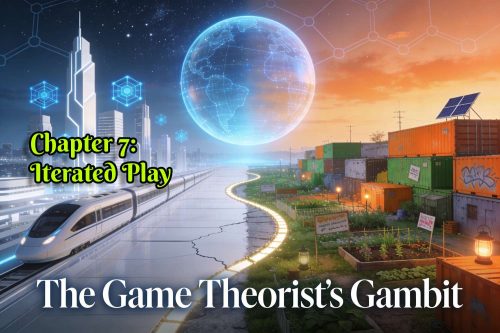
A rooftop overlooking both districts. Sunset.
The ladder was rusty and missing two rungs. Ava climbed it anyway, her shoes slipping on the old metal, her tablet tucked under one arm. Kai went first, pulling himself onto the tar-and-gravel roof with the ease of someone who had done this a hundred times. He reached down and offered her a hand.
She took it.
The roof was flat and wide, probably an old warehouse from the port days. From here, the city unfolded in both directions. To the west, New Athens Prime glittered—glass towers catching the last light, mag-lev trains sliding silently along their elevated tracks, the solar array glowing like a second sun. To the east, the Feral District spread out in a patchwork of shadows and warm, flickering lights—candles, maybe, or kerosene lamps. The garden was a dark green rectangle near the center.
Ava sat down on a folded tarp, her legs dangling over the edge. Kai sat beside her, close enough that their shoulders almost touched.
“You brought me up here to see something,” she said.
“I brought you up here to think.” He pulled something from his pocket—two small apples, slightly bruised, from the community garden. He handed her one. “Eat. You haven’t eaten all day.”
She hadn’t noticed. The past week had blurred into a constant stream of meetings, arguments, and failed models. She bit into the apple. It was tart and sweet and perfect.
They ate in silence as the sun dipped lower, painting the sky in shades of amber and violet. The Oracle’s weather algorithms had predicted clear skies until midnight. For once, Ava didn’t check.
“Tell me about the tournament,” Kai said finally.
Ava swallowed. “Which tournament?”
“The monthly cooperation tournament. The one you explained on our first day. Neighborhoods compete for grants based on average token balances.”
“What about it?”
“How long does it last?”
“A month. Then it resets.”
“And at the end of the month, what happens to the tokens people earned?”
“They get added to their permanent balances. But the tournament scores reset to zero. Every neighborhood starts fresh on the first.”
Kai turned to look at her. In the fading light, his eyes were dark and unreadable. “So on day twenty-nine of the tournament, if I know my neighborhood is going to lose no matter what—if I’m in last place—what’s stopping me from betraying my neighbor?”
Ava opened her mouth to answer, then stopped.
The math was clear. On day twenty-nine of a thirty-day tournament, the future value of cooperation was minimal. The grant was already lost. The token rewards for cooperation would be erased in two days anyway. So the rational choice—the utility-maximizing choice—was to defect. Take whatever short-term gain you could get. Hoard resources. Ignore your neighbors.
“There’s no penalty for betraying on day twenty-nine,” she said slowly.
“None. Because the game ends tomorrow.” Kai took a bite of his apple. “That’s the flaw in your entire system. Every tournament, every incentive, every game—they all have an end. And when players know the game is ending, they stop cooperating.”
Ava’s mind raced. She thought about the recycling chutes—token rewards for every deposit, but no penalty for stopping. She thought about the transit seats—yielding rewarded, but only if you did it in the moment. She thought about the civic efficiency quizzes—high scores rewarded, but then forgotten.
“Your games are one-off interactions,” Kai said. “Even the ones that repeat—the tournaments reset. The Oracle treats each month as a new game. It doesn’t remember last month. It doesn’t learn.”
“That’s not true. The Oracle uses historical data to adjust parameters—”
“It uses aggregated data. Trends. Statistics. It doesn’t remember that you helped me last Tuesday. It doesn’t track individual relationships. To the Oracle, every interaction between two citizens is a fresh start. No history. No reputation. No future.”
Ava set down her apple. Her hands were trembling slightly, but not from cold.
“You’re talking about iterated play,” she said.
Kai nodded. “The iterated Prisoner’s Dilemma. You know it better than I do.”
She did. Every game theory student learned the difference between a single-play and an iterated Prisoner’s Dilemma. In a single game, betrayal was the dominant strategy. But in an iterated game—where the same players faced each other repeatedly, with no fixed end—cooperation emerged naturally. Because if you betrayed today, the other player would betray you tomorrow. And the day after. And the day after that.
Over infinite rounds, the winning strategy was not betrayal. It was not even pure cooperation. It was tit-for-tat: start by cooperating, then mirror whatever the other player did last time. Simple. Forgiving. And, under the right conditions, unbeatable.
“The Oracle’s tournaments are not iterated,” Ava said. “They’re repeated, but with a fixed horizon. Thirty days. And when players know the horizon, they defect at the end. That’s the end-game problem.”
“Your city is built on the end-game problem,” Kai said quietly. “Everything resets. Every month. Every transaction. Every relationship. The Oracle doesn’t want us to remember each other. Because if we remembered, we wouldn’t need tokens.”
Ava stared out at the Feral District. The lights were flickering—candles, yes, and oil lamps, and a few solar-powered bulbs. People were cooking dinner, sharing meals, putting children to bed. No one was checking their token balance. No one was calculating the optimal time to betray.
They didn’t need to. Because they would see each other tomorrow. And the day after. And the day after that.
“The Warden’s airdrop,” Ava said. “The auction. It’s a one-off event.”
“Exactly. She’s asking people to betray their neighbors for tokens they’ll never see again. No future consequences. No reputation damage. Just a single game, and then the game ends.”
“That’s why the acceptance rate was so low,” Ava realized. “Not because people are irrational. Because they’re thinking long-term. They know they have to live with each other after the auction is over. Taking the tokens would destroy their reputation forever.”
Kai smiled. “Now you’re seeing it. My district isn’t full of saints. We’re selfish, same as everyone. But our selfishness is long-term. We cooperate because we have to face each other tomorrow.”
Ava pulled out her tablet. Her fingers flew across the screen, pulling up the Oracle’s core governance parameters.
The monthly tournament horizon: 30 days.
The reputation decay rate: 50% per month (old transactions halved in weight).
The maximum length of any incentive contract: 90 days.
Every single parameter was designed to prioritize short-term optimization. The Oracle assumed that the future was uncertain, so it discounted future rewards heavily. But in doing so, it had created exactly the behavior it feared: defection, betrayal, and the collapse of trust.
“The system fails,” Ava whispered, “because it doesn’t account for infinite play.”
“It doesn’t account for tomorrow,” Kai said.
The sun had set. The sky was deep blue, almost purple, with the first stars appearing. Neither of them moved.
Ava was still staring at her tablet, but she wasn’t really seeing it. Her mind was churning through the implications. If the Oracle’s problem was the time horizon—if the city was stuck in a series of one-off games—then the solution was not better incentives. It was longer games. Games that never ended.
“Cooperation doesn’t need to be enforced by tokens,” she said slowly. “It needs to be enforced by the future. If I know I’ll see you again, I’ll treat you well. Not because I’m good. Because it’s rational.”
“Rationality and goodness aren’t opposites,” Kai said. “That’s what your city forgot.”
Ava looked up at him. In the starlight, his face was half in shadow. “You’ve been saying that all along. That your district isn’t irrational. It’s playing a different game.”
“A longer game.”
“A game with no reset button.”
Kai nodded. “The Oracle thinks it’s optimizing for cooperation. But it’s actually optimizing for defection. Because every time it resets the tournament, it tells us that the past doesn’t matter. That today’s kindness won’t be remembered tomorrow. That the only thing that counts is the token in your hand, right now.”
Ava thought about the woman with the wallet. The old man with the groceries. The carrot from the garden. None of those acts had earned tokens. But they had been remembered. The people who received help had gone on to help others. Chains of cooperation, invisible to the Oracle, linking one act of kindness to the next.
“Your district has a reputation system,” she said. “Not a formal one. Not a ledger. But everyone knows who can be trusted. That’s worth more than any token balance.”
“Reputation is the only currency that matters,” Kai said. “But it takes time to build. Years. Decades. Your Oracle doesn’t have patience. It wants results now. So it designs games that end now. And then it wonders why no one trusts each other.”
Ava set down her tablet. She turned to face him fully.
“We need to build a game that never ends,” she said. “A game where helping your neighbor today means they help you tomorrow. A game where trust has compounding interest.”
Kai’s eyebrows rose. “That sounds like something I would say.”
“It is. I’ve been listening.” She smiled—a small, self-deprecating smile. “You’re a better game theorist than you think. You just don’t use math.”
“I use a different kind of math.”
“What kind?”
He reached out and tapped her temple, gently. “The kind that counts what matters.”
They sat on the rooftop for another hour, talking. The stars came out in full force—no light pollution here, at the edge of the city. Ava pointed out constellations she had learned from the Oracle’s astronomy modules. Kai pointed out constellations his grandmother had taught him, the old names, the stories behind them.
“You could build a whole game theory around constellations,” Ava said. “They’re a Schelling Point. Everyone sees the same stars, so everyone can coordinate on the same story.”
“Stories are better than incentives,” Kai said. “Incentives tell you what to do. Stories tell you who you are.”
Ava tucked that away in her memory. It felt like something she would need later.
“The Oracle is going to adjust its parameters,” she said finally. “After the low acceptance rate on the token offers, the Warden will push for a new approach. Probably harder enforcement. Shorter deadlines. More pressure.”
“You sound like you know her playbook.”
“I’ve studied it. The Warden believes in decisive action. If cooperation isn’t working, she’ll switch to coercion. That’s the next phase.”
“Then we need to be ready.”
“We need to build the alternative before she escalates.” Ava picked up her tablet again. A new idea was forming—not fully shaped, but bright at the edges. “What if we designed a smart contract that doesn’t reset? A game that rewards cooperation over time, not in isolated bursts. A token system that actually tracks reputation, not just transactions.”
Kai leaned over to look at the screen. “You’re talking about a positive-sum game.”
“I’m talking about a game that never ends.” She began to sketch—quick, messy lines, a flow diagram. “The Oracle’s mistake is treating every interaction as independent. But real life isn’t independent. Every choice you make affects your future opportunities. If you help someone today, they’re more likely to help you tomorrow. That’s not altruism. That’s just good strategy.”
“So you want to build a system that rewards long-term thinking.”
“I want to build a system that is long-term thinking.” She looked up at him. “The Oracle’s tournaments are one month. What if we made the tournament infinite? What if the rewards never reset, and the only way to earn tokens was to build a reputation for cooperation?”
Kai was quiet for a long moment. Then he said: “That sounds like a neighborhood.”
Ava blinked. “What?”
“A neighborhood. Where people know each other. Where your reputation follows you. Where you can’t run away from what you did yesterday because you’ll see the same faces tomorrow.” He gestured out at the Feral District, the warm flickering lights. “That’s what we have. It’s not a game. It’s just… life.”
Ava looked at her diagram. At the tokens and the smart contracts and the flow arrows. Then she looked at the district—the real district, the one with candles and gardens and shared meals.
“Maybe the game should just be life,” she said quietly. “Maybe we don’t need to design anything. Maybe we just need to stop resetting the board.”
Kai smiled. “Now you’re talking like a Feraller.”
“Is that an insult?”
“It’s a compliment.”
They climbed down from the roof as the temperature dropped. At the bottom of the ladder, Kai hesitated.
“Ava,” he said. “The Warden isn’t going to give us time. She’s already planning the next move.”
“I know.”
“Whatever you’re designing—the infinite game, the positive-sum contract—you need to do it fast.”
Ava nodded. She looked at her tablet, at the half-finished diagram. Then she looked at Kai, at the tired lines around his eyes, at the way he stood with his hands in his pockets, watching her like she might disappear.
“I’ll work through the night,” she said. “There’s a smart contract template I rejected last year. ‘Too speculative,’ the Oracle said. But maybe it’s exactly what we need.”
“What does it do?”
She smiled—a real smile, the kind she hadn’t worn in days. “It rewards people for helping each other. Not once. Every time. And it never forgets.”
Kai studied her face. Then he nodded.
“Tomorrow,” he said.
“Tomorrow,” she agreed.
She walked toward the border, her tablet clutched to her chest. Behind her, the Feral District glowed with a million small, unoptimized lights. Ahead of her, New Athens Prime hummed with perfect, lonely efficiency.
She was about to build a bridge between them.
And she was going to make sure that bridge never burned down.
Table of contents:
Introduction
Prologue: The Prisoner’s Dilemma of New Athens
Chapter 1: The Incentive Architecture
Chapter 2: The Nash Equilibrium Slum
Chapter 3: A Suboptimal Player
Chapter 4: The Schelling Point Revolt
Chapter 5: Zero-Sum Streets
Chapter 6: The Byzantine Neighborhood
Chapter 7: Iterated Play
Chapter 8: The Cooperative Airdrop <<<<<< NEXT
Chapter 9: A Positive-Sum City
