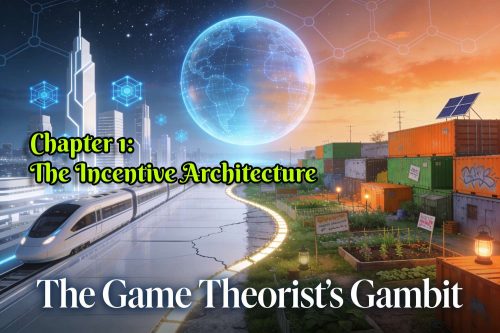
Present day. Three years after the annexation of the Feral District. Ava’s district, New Athens Prime.
The morning light in New Athens Prime was the color of clean water—pale blue and filtered through exactly the right density of atmospheric particulates. The city’s weather algorithms had decided on a light breeze from the east, carrying the faint scent of jasmine from the public gardens. Ava Kostas stepped out of her apartment building and breathed it in.
She was seventeen now. Taller than she had been in that white classroom, but still carrying the same straight-backed posture, the same careful stillness. Her wristband was a sleek silver band, barely thicker than a thread, displaying her current Reputation Token balance: 3,247. Top fifteen percent for her age cohort. Not the highest—Marcus had somehow clawed his way to 4,100—but respectable. Efficient.
Today, however, her wristband displayed an additional notification. A message from the City Coordination Office, marked URGENT – CULTURAL EXCHANGE PROTOCOL.
*You have been assigned as a guide for one (1) visitor from the Feral District. Duration: 72 hours. Objective: Demonstrate optimal civic participation. Reward upon completion: 150 tokens. Penalty for non-compliance: -75 tokens per infraction.*
Ava had read the message three times. The Feral District. She had never been there—few in Prime had. She knew it only as a data anomaly on the Oracle’s public dashboards: low trust indices, negative cooperation coefficients, a Nash Equilibrium classified as “poverty trap.” Three years ago, the city had annexed it, absorbing its chaotic sprawl into New Athens’s legal framework. But the Oracle had never been able to optimize it. The residents refused to play the games.
And now one of them was coming here.
She spotted him at the designated meeting point: the fountain in Civic Plaza Number Four. He was sitting on the edge of the basin, not on the designated seating pads (those were for resting only, and required a +0.1 token scan to activate). His clothes were simple—a grey jacket, worn at the elbows, dark trousers with a patch on one knee. His wristband was not the standard silver. It was thicker, clunkier, a leftover from before the annexation, its screen cracked and its interface flickering between obsolete protocol versions.
His name, according to the message, was Kai.
He was looking at the fountain with an expression Ava could not immediately categorize. Not wonder. Not disdain. Something closer to appraisal—as if he were trying to read the hidden rules beneath the visible surface.
She approached. “Kai?”
He turned. His eyes were dark and steady. “Ava.”
“You know my name.”
“The message included your profile. Top performer in Game Theory Architecture. Designed the incentive structure for the Southeast Recycling Tournament last quarter. Seventy-three percent reduction in contamination rates. Impressive.”
Ava blinked. She was not used to being read so quickly. “You researched me.”
“You’re my guide. I wanted to know who I was walking into a game with.”
“It’s not a game,” she said, and then stopped. Everything in New Athens was a game. “I mean—the exchange is designed to be mutually beneficial. You’ll learn about our systems. I’ll earn tokens. The city gets cross-district data. Positive-sum.”
Kai stood up. He was a few inches taller than her. “That’s what the message said. Let’s see if it’s true.”
The tour began at the recycling hub.
Ava had chosen this as the first stop for a reason. The hub was a masterpiece of incentive architecture—a gleaming semicircle of chutes, each labeled with a material type and a digital display showing real-time token rewards. A woman approached, carrying a basket of sorted waste. She deposited a glass bottle into the green chute.
Ding. The woman’s wristband glowed green. +0.1 tokens.
A plastic container into the blue chute.
Ding. +0.1.
A crumpled receipt into the grey chute (non-recyclable, but proper disposal still rewarded).
Ding. +0.05.
The woman walked away without breaking stride. She had performed the action thousands of times. It was as automatic as breathing.
“Do you see?” Ava said, gesturing. “No litter. No contamination. Every citizen has an incentive to dispose of waste correctly. The city spends almost nothing on cleaning crews.”
Kai watched the chutes for a long moment. “What happens if someone puts the wrong thing in the wrong chute?”
“The scanner detects it. The item is ejected back out, and the user loses 0.2 tokens as a penalty for incorrect sorting. After three violations in a month, they lose access to the recycling system entirely and must use the manual disposal station—which has no token rewards.”
“So the penalty scales.”
“Precisely. The cost of learning is low, but the cost of willful negligence is high. It’s a graded incentive structure. Very elegant.”
Kai said nothing. He was looking at the woman who had just recycled her items. She was already walking toward the transit station, her face blank, her wristband already calculating her next optimal move.
“Does she enjoy it?” Kai asked.
“Enjoy what?”
“Recycling.”
Ava frowned. “It’s not about enjoyment. It’s about alignment. Her private incentive—earning tokens—aligns with the public good—a clean city. She doesn’t need to enjoy it. She just needs to do it.”
Kai nodded slowly. “In my district, we have a compost pile. No tokens. No scanners. People bring their food scraps because the garden needs soil, and the garden feeds everyone. It’s not efficient. Sometimes people forget. But the people who bring scraps—they enjoy it. They like seeing the tomatoes grow.”
“That’s lovely,” Ava said, and meant it, but also felt a small spike of impatience. “But it doesn’t scale. A compost pile works for a hundred people. New Athens has three million. You need an incentive architecture.”
“You need trust,” Kai said. “But let’s keep walking.”
They crossed through a small park. The grass was manicured to exactly 3.2 centimeters—the optimal height for carbon sequestration per square meter, according to the Oracle’s landscaping models. Paths curved in mathematically determined arcs to maximize foot traffic efficiency.
A boy, maybe eight years old, broke away from his mother and ran across the grass. Not on the path. Directly over the lawn.
His wristband flashed red. A sharp buzz sound, audible from twenty meters away.
*Penalty: -0.5 tokens for inefficient traversal. Please use designated pathways.*
The boy’s face crumpled. His mother grabbed his hand and pulled him back to the path, muttering something about checking his balance later. The boy did not cry, but his shoulders slumped in a way that made Ava’s chest tighten for reasons she could not name.
“The paths are optimal,” she said quickly, to fill the silence. “Walking on the grass compresses the soil and damages the root systems. The penalty is a disincentive for behavior that harms a shared resource.”
Kai had stopped walking. He was watching the boy, who was now trudging along the path with his head down.
“How many tokens does that kid have?” Kai asked.
Ava checked her wristband. The Oracle did not share individual balances publicly, but she could see aggregated data for the area. “Average for his age is around 400.”
“So losing half a token is noticeable.”
“Very. Tokens determine access to everything—better housing, faster transit, preferred school placement. A child with low tokens might end up in a less optimal learning track.”
Kai turned to look at her. His expression had changed. He was not angry, exactly. But something behind his eyes had gone very still.
“So your system teaches children that running on grass is a moral failure. That joy has a price. That the natural impulse to play is a debt to be repaid.”
Ava opened her mouth to respond, to explain the math, the necessity, the tragedy of the commons. But the words felt suddenly thin.
“The system teaches efficiency,” she said instead. “That’s not the same as morality.”
“Isn’t it?” Kai asked. And then, before she could answer, he started walking again.
They reached the transit station. A mag-lev bus slid into its berth with a pneumatic hiss. Ava scanned her wristband—*ding, -0.2 tokens, fare deducted*—and gestured for Kai to do the same. His clunky band emitted a scratchy beep, but the reader accepted it.
The bus was nearly full. A digital display above the door scrolled messages:
*Seats are a common-pool resource. Yield to elderly for +0.3 tokens.*
*Standing passengers, please hold the overhead rails. Failure to do so may result in a -0.1 penalty for safety non-compliance.*
Thank you for riding with New Athens Transit. Your cooperation improves travel time for everyone.
Ava found a seat near the back. Kai stood in the aisle, looking around. An elderly man with a cane stood near the front, holding the rail with trembling fingers. Three younger passengers sat in the priority seats. Their wristbands glowed with active prompts—the yield reward was being displayed.
Ava watched them calculate. She could almost see the equations running behind their eyes: *0.3 tokens is small, but the bus ride is only four stops. If I yield, I stand for four minutes. Is that worth 0.3? Alternatively, if I don’t yield, will anyone penalize me? The Oracle doesn’t penalize non-yielding—it only rewards yielding. So the rational choice is to stay seated unless the token value exceeds my discomfort.*
None of them moved.
The elderly man braced himself as the bus began to move. He wobbled.
Kai stepped forward. He did not look at the seated passengers. He did not check his wristband. He simply reached out, gently took the man’s arm, and guided him to a spot near the rail where he could hold on more securely.
“There’s no seat,” Kai said quietly. “But this rail is lower. Easier to grip.”
The man nodded, grateful. “Thank you, son.”
The bus continued. The seated passengers looked away. Their wristbands had stopped glowing—the yield opportunity had expired.
Kai returned to stand next to Ava.
“That was—” she started.
“Stupid?” he said. “I know. No tokens for helping someone find a better rail. The system didn’t design a game for that.”
“I was going to say ‘kind,'” Ava said. “But also inefficient. You could have earned 0.3 tokens by yielding a seat. Instead, you earned nothing.”
“He needed help. Not a token.”
Ava fell silent. She was calculating, but not tokens. She was recalculating her initial assessment of Kai. He was not ignorant of the system. He understood it perfectly. He just chose not to play.
That was either irrational or… or something else. Something her models did not have a variable for.
The bus arrived at the last stop on Ava’s planned route: the boundary between her district and the commercial zone. She was about to suggest lunch when it happened.
A woman in a business jacket—probably on her way to a coordination meeting, given the time of day—exited the bus ahead of them. She was carrying a briefcase in one hand and a tablet in the other. As she stepped onto the platform, her tablet slipped. She fumbled, caught it, but in the process, her wallet fell from her jacket pocket.
It landed on the ground. Open. A few coins—old physical currency, mostly ceremonial—scattered.
The woman did not notice. She was already walking toward the escalator, absorbed in her tablet.
Ava saw it. The three passengers who had exited behind the woman saw it. A teenager with a skateboard saw it. They all saw it.
Ava’s wristband did not prompt her. There was no game for “returning a dropped wallet.” The Oracle had never designed one because the expected frequency was low and the verification problem was high—how would the system know the wallet’s original owner? How would it prevent fraud?
So there was no reward. No penalty. No game at all.
The three passengers looked at the wallet. Then at each other. Then at their wristbands. A silent calculation. If I return it, I spend time chasing down a stranger. No tokens. If I leave it, someone else might take it. Not my problem.
The teenager with the skateboard nudged the wallet with his foot. He looked at it. He looked at his wristband. He looked at the wallet again.
Then he walked away.
The other two passengers followed.
Ava stood frozen. She wanted to pick up the wallet. She did. But her feet would not move. Because her mind was already running the calculation: If I return it, I earn nothing. If I keep it, the coins are worthless—everything is digital now. There’s no upside. But there’s also no downside. So why am I hesitating?
Because it was wrong. That was why. Not inefficient. Not suboptimal. Wrong.
Before she could move, Kai was already there.
He knelt down. He gathered the scattered coins. He closed the wallet. He looked at the woman’s retreating back—she was at the escalator now, about to descend—and jogged after her.
“Excuse me,” he called. “You dropped this.”
The woman turned. She saw the wallet. Her hand flew to her pocket. Her face went through surprise, then relief, then confusion.
“Oh. Thank you. I didn’t—when did—”
Kai handed it to her. “Just now. On the platform. You were focused on your tablet.”
The woman looked at him. Then at the wallet. Then at his worn jacket and his clunky wristband.
“You’re from the Feral District,” she said. Not a question.
“Yes.”
She paused. Ava could see her recalculating—reassessing the interaction through the lens of the system’s trust indices. Feral District residents have low cooperation scores. Why did he help me? What does he want?
What she said, finally, was: “Thank you.” And then she walked away. No token transfer. No smart contract. Just two words.
Kai returned to Ava. His expression was unreadable.
“That was inefficient,” Ava heard herself say. The words came out sharper than she intended. “You should have reported it through the lost-and-found smart contract. There’s a standard protocol—you scan the item, submit a claim, and the owner gets a notification. The system guarantees a return reward of 0.5 tokens. It’s designed to solve exactly this kind of—”
“She needed it now,” Kai said.
“She would have gotten it back. The system works.”
“The system works for people who have time to wait. For people who trust that the notification will come. For people who aren’t already late to a meeting because their tablet crashed and their wristband is giving them conflicting prompts.” He looked at the escalator where the woman had disappeared. “She was stressed. Her shoulders were tight. She kept checking the time. She needed her wallet now, not in an hour, not after a verification process, not with a 0.5 token reward attached.”
Ava had no response. Because he was right. She had seen the same tension in the woman’s posture. She had noted it, categorized it as “non-optimal affective state,” and moved on. Kai had seen it and acted.
“You lost tokens by helping her,” Ava said finally. “Your balance. It must have taken a hit.”
Kai held up his wristband. The cracked screen showed his balance: 112 tokens. Barely above the poverty threshold.
“I’m always losing tokens,” he said. “The system wasn’t built for me. It was built for you.”
He started walking again, toward the commercial zone. Ava followed, her mind churning.
She pulled up his profile on her wristband. The Oracle’s classification was stark:
*Subject: Kai, 16. District of origin: Feral (annexed). Cooperation index: 41/100 (suboptimal). Rationality score: 63/100 (below threshold). Behavioral flags: excessive altruistic acts (uncompensated), repeated failure to prioritize token-earning activities, suspected empathy-driven decision-making. Recommendation: remedial incentive training or relocation to supervised cohort.*
But then she looked at the raw data. The actual transactions. Every time Kai had helped someone—carrying groceries, fixing a broken chair, watching a neighbor’s child—he had lost tokens. The system had penalized him for missing token-earning opportunities. His balance had dropped. His flags had multiplied.
And yet.
And yet, the people he helped had gone on to help others. Ava found three chains in the data—cases where a person Kai assisted had, within 48 hours, performed an unsolicited cooperative act for someone else. The Oracle had not rewarded those chains. It had not even noticed them. But they were there.
Ava stopped walking.
He’s not a bug, she thought. He’s a variable I don’t have an equation for.
Kai turned to look at her. “You coming? Or does your itinerary say we have to stand here for exactly four more minutes?”
Ava looked at her wristband. The tour schedule was already off by seven minutes. She would lose a small efficiency bonus if she didn’t catch up.
She dismissed the schedule.
“I’m coming,” she said. And for the first time all day, she walked without calculating the optimal path.
Table of contents:
Introduction
Prologue: The Prisoner’s Dilemma of New Athens
Chapter 1: The Incentive Architecture
Chapter 2: The Nash Equilibrium Slum <<<<<< NEXT
Chapter 3: A Suboptimal Player
Chapter 4: The Schelling Point Revolt
Chapter 5: Zero-Sum Streets
Chapter 6: The Byzantine Neighborhood
Chapter 7: Iterated Play
Chapter 8: The Cooperative Airdrop
Chapter 9: A Positive-Sum City
