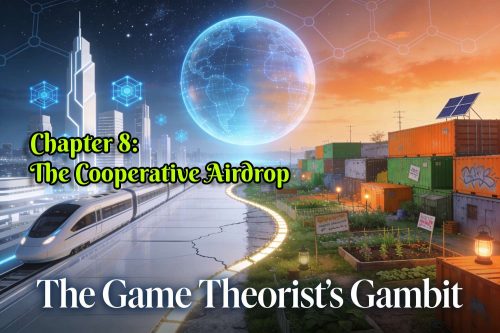
Ava’s lab, New Athens Prime. Three days after the rooftop conversation.
The lab was a mess.
This was unusual. Ava had always kept her workspace immaculate—tablets stacked by size, styluses aligned in a polished holder, the walls adorned with crisp flowcharts and token-efficiency graphs. But the past seventy-two hours had transformed the room into a battlefield. Printouts covered every surface. Half-empty coffee mugs formed a defensive perimeter around her main terminal. The whiteboard, once a masterpiece of clean equations, was now a chaotic tangle of arrows, crossed-out formulas, and one phrase written in angry red: NO RESET.
Kai stood in the doorway, holding two carrots and a thermos of something hot. He had never been invited to the lab before. The journey here—through the gleaming corridors of Prime, past citizens who stared at his worn jacket and cracked wristband—had been uncomfortable. But Ava had insisted.
“You look terrible,” he said.
“I’ve been awake for forty-seven hours.” Ava didn’t look up from her terminal. Her fingers flew across the holographic keyboard, pulling up smart contract templates, modifying parameters, running simulations. “But I think I have it.”
Kai set the carrots and thermos on the only clear corner of the desk. “Have what?”
She spun around. Her eyes were bloodshot, but they were bright—brighter than he had ever seen them.
“The Cooperative Airdrop.”
She gestured at the main display. A smart contract bloomed across the screen—not the dense, impenetrable code of most Oracle protocols, but something cleaner, simpler. Ava had written it in a new language, one she had been developing in secret for months. She called it TrustScript.
“It’s not an auction,” she said. “It’s not a redistribution. It’s a generation engine.”
Kai stepped closer, reading over her shoulder. The screen showed a flow diagram:
ACT → VERIFICATION → TOKEN RELEASE → REPUTATION UPDATE
But the “ACT” node was not a simple transaction. It was a branching tree of possibilities.
TEACHING (skill transfer, verified by both parties)
SHARING (tools, food, space, verified by recipient)
REPAIRING (fixing broken infrastructure, verified by community)
CARING (childcare, eldercare, health support, verified by care recipient)
GROWING (food production, garden expansion, verified by harvest share)
Each act had a token value attached—not fixed, but dynamic. The more scarce the skill or resource, the higher the reward. The more frequently an act was performed, the lower the marginal reward (to prevent gaming). The longer a relationship lasted, the higher the trust multiplier.
Kai stared at the screen. “This is…”
“Insane? The Oracle rejected it last year. ‘Too speculative. Too difficult to verify. Too vulnerable to false reporting.’ But I’ve been working on the verification problem.”
She pulled up a second screen. This one showed a simple interface: two buttons. CONFIRM and REPORT. Below them, a timer.
“Mutual attestation,” Ava said. “Both parties must confirm that a cooperative act occurred. If only one confirms, the contract flags it for human review—or, in our case, community review. If someone is caught filing a false report, they lose tokens. Not a small penalty—a catastrophic one. Enough to make lying irrational.”
Kai traced the logic. “So you can’t just claim you helped someone. They have to agree.”
“Exactly. And if you help someone and they refuse to confirm out of spite, the contract has a fallback—witness attestation. Any third party who saw the act can confirm it. But the witness also faces penalties for false reporting. The system is designed to make truth the easiest path.”
He looked at her. “You’ve been thinking about this for a long time.”
“Since the wallet,” Ava admitted. “Since I watched you help that woman and earn nothing. I kept asking myself: why doesn’t the system have a category for that? And then I realized—it doesn’t have a category because no one ever wrote one. So I wrote one.”
She turned back to the terminal and began scrolling through the contract’s parameters. “The key innovation is the time horizon. The Oracle’s tournaments reset every month. This contract never resets. Every cooperative act you’ve ever done stays in your reputation record. Forever.”
“Forever?”
“Forever. But the weight decays slowly—one percent per month. So recent acts matter more than ancient history, but nothing is ever completely forgotten. That’s the iterated play solution. When you know your reputation follows you for life, cooperation becomes the dominant strategy.”
Kai was quiet for a long moment. Then he said, quietly: “You built a neighborhood.”
Ava looked up. “What?”
“You built a neighborhood. In code. With reputation and trust and long-term relationships. That’s what neighborhoods are.”
She smiled—a tired, genuine smile. “Maybe. But neighborhoods can’t scale to three million people. Code can.”
The Warden’s office. Later that day.
Director Sorensen sat behind a desk made of recycled carbon fiber. Her office was as immaculate as Ava’s lab had been chaotic—not a single object out of place, not a single pixel of light wasted. The walls were screens, displaying real-time data feeds from every district in New Athens. The Feral District glowed an angry red.
Ava stood before the desk, Kai beside her. The Warden had not offered them seats.
“You want me to approve a smart contract that rewards people for… being nice to each other.” The Warden’s voice was flat.
“Cooperative acts,” Ava said. “Verified by mutual attestation. The contract releases development tokens only when both parties confirm that a transfer of value—skill, labor, resources—has occurred.”
“And these tokens come from where?”
“From a new issuance. A dedicated pool, separate from the main token economy. The Oracle can mint them at a controlled rate, tied to verifiable increases in social utility.”
The Warden stared at her. “You want to print money for holding hands.”
“I want to print money for trust.” Ava stepped forward, tapping the Warden’s desk to bring up a projection. “Look at the data from the Feral District. The Oracle’s models show zero economic activity. But we know that’s false. People are teaching each other, sharing food, repairing homes. That’s real value. The Cooperative Airdrop simply measures that value and rewards it.”
The Warden’s eyes flicked to the projection. For a moment, something almost like curiosity crossed her face. Then it was gone.
“This is sentimental nonsense,” she said. “You cannot build a city on unverifiable kindness. What happens when two people collude—both confirm a false act, split the tokens, and walk away?”
“The penalty for false confirmation is catastrophic. Loss of all future token privileges. Permanent reputation flag. No appeals.”
“And if they don’t care about reputation?”
Ava glanced at Kai. He nodded slightly.
“Then they’re not playing the long game,” Ava said. “And in the long game, they lose. Because reputation is the only currency that matters over time. The Oracle’s mistake was treating every transaction as independent. People aren’t independent. They remember.”
The Warden stood up. She was taller than Ava remembered, her presence filling the room like cold air.
“You’re seventeen years old,” she said. “You’ve designed a few recycling tournaments. You’ve never managed a city. And now you want to rewrite the foundation of our entire incentive architecture because you met a boy from the slums who gave you a carrot.”
Kai tensed beside Ava. But Ava did not flinch.
“I want to rewrite it because it’s broken,” she said. “Your auction will fail. The Feral District won’t participate. You’ll escalate to force, and the city will watch, and they’ll see that the Oracle’s games only work when everyone agrees to play. But people don’t have to play. They can refuse. And when they refuse, your models break.”
The Warden’s jaw tightened. “The Oracle’s models—”
“The Oracle’s models predicted an 18-24% acceptance rate for your token offers. The actual rate was 1.9%. Your models are wrong, Director. Not because the math is bad. Because the assumptions are wrong. You assumed people are rational in the narrow, short-term sense. But people are rational in the long-term sense. They cooperate because they have to live with each other. Your games ignore that. Ours doesn’t.”
Silence.
The Warden looked at Ava. Then at Kai. Then back at the projection—the contract, the trust flows, the infinite time horizon.
“This contract has never been tested,” she said finally.
“Then let us test it,” Kai said. His voice was calm. “One district. Six months. If it fails, you can do whatever you want with the Feral District. We won’t resist.”
“And if it succeeds?”
Kai looked at Ava. She looked back.
“Then you roll it out city-wide,” Ava said. “And New Athens becomes what it was always supposed to be. A place where the rational choice is kindness.”
The Warden stood motionless for a full ten seconds. Then she sat down.
“I will bring it to the Oracle,” she said. “But the Oracle has rejected this contract before. It will reject it again.”
“Let it try,” Ava said.
The Oracle’s core processing chamber. That night.
Ava had never been here before. Few citizens had.
The chamber was deep beneath City Hall, a vast spherical room filled with humming server racks and cooling pipes. At the center, a floating holographic sphere pulsed with soft blue light—the Oracle’s physical interface, the face it showed to the world.
Ava stood on a platform before the sphere. Kai waited at the entrance, not permitted further. Only certified Architects could address the Oracle directly.
“Contract submission 19-47-Alpha,” Ava said. “The Cooperative Airdrop. Resubmitted for evaluation.”
The Oracle’s sphere pulsed. A voice—neutral, calm, neither male nor female—filled the chamber.
“Contract recognized. Previous evaluation: Rejected. Reason: Excessive speculative variables. Verification mechanism untested. Potential for systemic gaming.”
“I’ve addressed those concerns,” Ava said. “The mutual attestation protocol includes catastrophic penalties for false reporting. The dynamic reward curve prevents farming. The infinite time horizon aligns individual incentives with long-term social utility.”
“Analyzing.”
The sphere flickered. Data streams cascaded across its surface—millions of calculations per second. Ava held her breath.
“Analysis complete. The contract remains high-risk. However, recent anomalies in the Feral District—specifically, the unexpected cooperation cascade following a ‘suboptimal player’ event—suggest that current models may undervalue long-term trust dynamics.”
Ava blinked. The Oracle had never admitted a potential flaw in its own models.
“Proposed resolution: Limited pilot. One district. Six months. The Oracle will monitor all transactions. If the contract increases verifiable social utility beyond current baselines, it will be considered for city-wide adoption.”
“Yes,” Ava said. “That’s what we’re asking for.”
“Conditional approval granted. The Warden’s consent is required for implementation.”
“I have it.” She hoped. The Warden had not committed.
“Then the pilot will begin at midnight. The Oracle will mint an initial token pool of 100,000 units. Cooperative acts logged and verified will trigger token releases. All data will be公开 for analysis.”
Ava’s heart pounded. “Thank you.”
The sphere pulsed once, then dimmed. The audience was over.
She walked back to Kai, her legs trembling slightly.
“What did it say?” he asked.
“It said yes. Conditionally. But—”
“But what?”
Ava looked at him. “The Warden still has to approve. And she’s not convinced.”
Kai put a hand on her shoulder. “Then we convince her.”
The citizen referendum. Civic Plaza Number Four. Two days later.
The Warden had not expected this.
Ava and Kai had spent the intervening forty-eight hours organizing—not through the Oracle’s official channels, but through old-fashioned methods. Hand-painted signs. Door-to-door conversations. Town meetings in the Feral District’s warehouse. A petition, written on paper, carried from house to house.
By the morning of the vote, the petition had 47,000 signatures. Enough to trigger a binding citizen referendum under New Athens’s rarely-used charter.
The plaza was full. Citizens from Prime stood alongside residents from the Feral District. The sleek digital displays had been supplemented with hand-lettered signs: COOPERATION NOT COMPETITION. TRUST NOT TOKENS. BAKE BREAD NOT PIE.
The Warden stood on the central platform, flanked by security drones. Her expression was unreadable.
“This is unprecedented,” she said into the microphone. “A citizen referendum on a smart contract. The Oracle has already approved a pilot. There is no need for—”
“There’s every need,” Kai called out from the crowd. “Because if the pilot fails, you’ll use it as an excuse to destroy our homes. We want a binding commitment. Six months. No interference. No early termination.”
The crowd murmured. The Warden’s jaw tightened.
“The Oracle’s decision is final—”
“The Oracle serves the citizens,” Ava said, stepping forward. She had never spoken in front of so many people. Her voice shook, but she kept going. “That’s what the charter says. ‘The Oracle shall optimize for the well-being of all citizens, as defined by their expressed preferences.’ We’re expressing our preference. We want to try something new.”
She held up the petition. 47,000 names.
“The charter requires a simple majority for referendums affecting a single district. The Feral District has 42,000 residents. We have 47,000 signatures. That’s already a majority of the affected population, even without Prime’s votes.”
The Warden stared at the petition. Then at the crowd. Then at her wristband, where the Oracle’s data feed was presumably telling her the same thing.
“Fine,” she said. “The referendum will proceed. Electronic voting will begin now and close at midnight. If a majority of Feral District residents approve the pilot, and a simple majority of Prime residents do not veto it, the contract will go live.”
She stepped down from the platform. As she passed Ava, she whispered: “You’re making a mistake. This contract will fail. And when it does, I won’t be generous.”
Ava watched her walk away. Then she turned to the crowd.
“We have twelve hours,” she said. “Let’s make them count.”
Midnight. The community garden.
The votes were counted.
Ava stood beneath the wooden archway, her tablet displaying the results. Kai stood beside her, surrounded by dozens of Feral District residents who had refused to go home.
Feral District approval: 89%
Prime veto: 12% (insufficient to block)
“The pilot is approved,” Ava said. Her voice cracked. “The Cooperative Airdrop goes live at midnight.”
The crowd erupted. Not in cheers—in something quieter. Hugs. Tears. The woman with the gray braids knelt down and touched the soil. Elias, the hoarder, stood at the edge of the garden, his arms still crossed, but his eyes glistening.
Kai turned to Ava. “You did it.”
“We did it,” she said. “I couldn’t have written the contract without what you taught me. The infinite game. The long-term view. The fact that people are more than their utility functions.”
He smiled. “You taught yourself. I just gave you carrots.”
She laughed—a real laugh, the first in days. “The carrots helped.”
A chime sounded from her tablet. The Oracle’s voice, soft and neutral:
“The Cooperative Airdrop is now live. Initial token pool: 100,000 units. First cooperative act logged: Miriam’s Kitchen, Feral District. Act type: Food sharing. Verification: Mutual attestation confirmed. Tokens released: 50 to preparer, 50 to recipients.”
Ava stared at the screen. The very first act. Someone had already used the contract.
She looked up at Kai. “It’s working.”
“Let’s see if it keeps working.”
They stood together in the garden, surrounded by their neighbors, as the first tokens of the new system flowed into the hands of people who had never needed them to be kind. The Oracle watched. The Warden waited. And somewhere in the dark, the future was already beginning.
Ava touched her wristband. Her balance had not changed—she had not logged any acts yet. But for the first time, she didn’t care about the number.
She had built something better than tokens.
She had built a reason to trust.
Table of contents:
Introduction
Prologue: The Prisoner’s Dilemma of New Athens
Chapter 1: The Incentive Architecture
Chapter 2: The Nash Equilibrium Slum
Chapter 3: A Suboptimal Player
Chapter 4: The Schelling Point Revolt
Chapter 5: Zero-Sum Streets
Chapter 6: The Byzantine Neighborhood
Chapter 7: Iterated Play
Chapter 8: The Cooperative Airdrop
Chapter 9: A Positive-Sum City <<<<<< NEXT
