The Watchtower had no windows, no clocks, no sense of passing time. It existed outside the normal flow of Cryptopolis, a sterile bubble of purpose suspended in the digital void. Mateo and Skye had been in it for what felt like hours, though neither could say for certain. The countdown on the display had ticked from seventy-two hours to sixty-eight, then to sixty-seven, each number a small, relentless reminder of the pressure building around them.
They worked in parallel, their investigations running on separate tracks but converging on the same target. Mateo hunched over the Mainnet validator registry, his fingers tracing patterns in the data like a scholar reading ancient text. Skye moved through Nova’s transaction history with the speed of someone who had built half the systems she was now searching.
Neither spoke. The hostility of their first meeting hadn’t vanished, but it had been temporarily suspended—a truce enforced by mutual necessity. Every few minutes, one of them would project a finding onto the shared table, and the other would glance at it, nod, and continue working. It wasn’t collaboration, not yet. But it was something.
Mateo was deep in the validator logs when he found the first crack.
“Here,” he said, his voice rough from hours of silence. He expanded a section of the registry, highlighting a sequence of timestamps. “The dormant validators. The ones whose keys were used in the false batch.”
Skye looked up from her own displays, crossing the room to stand beside him. “What about them?”
“Look at the deactivation dates.” He pointed to a column of timestamps. “They were all marked dormant on the same day. Six months ago. A routine key rotation, according to the logs. Their old keys were supposed to be retired. New keys were issued. Standard procedure.”
Skye studied the data, her brow furrowing. “But the signatures on the false batch used the old keys. The retired ones.”
“Exactly.” Mateo expanded another window, showing the batch’s cryptographic signature. “The system shouldn’t have accepted these. Once a key is retired, it’s supposed to be blacklisted. Any transaction signed with it should be automatically rejected.”
“Unless someone changed the blacklist.”
Mateo shook his head. “I checked. The blacklist is intact. The retired keys are still on it. The system should have flagged this batch the moment it saw those signatures.”
Skye was quiet for a moment, processing. Then her eyes widened. “Unless the system did flag it. Unless someone made sure the flag was ignored.”
She pulled up her own data, projecting it next to Mateo’s. “The funding network I’ve been tracing. The wallets that fed the attacker. They’re not just random accounts. Look at the transaction patterns.”
Mateo watched as she highlighted a series of micro-transactions. They were tiny—fractions of tokens—but they moved with mechanical precision. Every six hours, like clockwork, a small amount flowed from a cluster of source wallets into a central accumulator.
“Six hours,” Mateo murmured. “That’s the bridge’s low-activity window. The time when traffic is lightest, when the Guardians do their deepest system checks.”
“Right.” Skye expanded the view, showing the pattern repeated across dozens of wallets. “Whoever built this network knew the bridge’s schedule. They knew exactly when to move funds to avoid detection. They’ve been doing this for months.”
Mateo stepped back from the table, his mind racing. The pieces were starting to fit together, but the shape they formed was troubling. This wasn’t just technical skill. This was institutional knowledge. The kind of knowledge that came from being inside the system.
“The validators,” he said slowly. “The ones whose keys were used. Who were they?”
Skye pulled up the validator profiles, scanning quickly. “Standard Mainnet validators. Mid-level operators. None of them were major players, but they’d been active for years before retirement. Good standing. No complaints. No—” She stopped.
“What?”
She pointed at one of the profiles. “This one. Validator #784. Name redacted, but look at his activity history. Six months ago, right before he was retired, he processed a batch from Nova that had an anomaly.”
Mateo leaned in. “What kind of anomaly?”
“Minor. A data packet that didn’t quite match the expected format. The system logged it, but it was cleared within minutes. No investigation. No follow-up.” She looked at Mateo. “It was a test. A dry run. They were seeing if anyone would notice a small irregularity. When no one did, they knew they could push something bigger.”
Mateo felt a chill run down his spine. “They’ve been planning this for six months. Maybe longer. The dormant keys, the funding network, the dry run—they built this attack piece by piece, waiting for the right moment.”
“And now they’re waiting for the next moment.” Skye gestured at the countdown. “Seventy-two hours. That’s not a threat. That’s a deadline. They’re going to do it again. Bigger this time.”
The weight of the realization settled over them. They weren’t just investigating a crime. They were racing against a clock set by someone who had already proven they could outthink the system.
Mateo’s wrist-comm pulsed. A message from the Mainnet elders’ council, the third since the crisis began. Status report required. What have you discovered?
He ignored it. There was no time to translate their findings into the language of officialdom. Not yet.
“We need to find the connection,” he said. “Between the dormant validators and the funding network. There has to be a link. Someone who knew both sides—who knew which validators were retiring, and how to build a wallet network that would escape notice.”
Skye nodded, already pulling up new searches. “I’ll cross-reference the validator profiles with Nova’s user database. Anyone who had accounts on both chains. Anyone who moved between them.”
“I’ll dig into the validators’ personal histories. Their families, their associates, anyone who might have had access to their keys.” Mateo paused. “This is going to take time. We have—” He glanced at the countdown. “Sixty-six hours. It’s not enough.”
“Then we work faster.” Skye’s voice was steady, but there was an edge to it now. Not fear. Determination. “And we stop pretending we’re on different sides. You know Mainnet. I know Nova. Together, we might actually stand a chance.”
Mateo looked at her. For a moment, the tension between them flickered—not gone, but diminished. She was right. They were each half of a solution. The question was whether they could become a whole.
“Show me how you trace the wallets,” he said. “The techniques you use. If I understand your tools, I can help you search faster.”
Skye almost smiled. Almost. “Okay. But first, show me how you verify validator signatures. If I can see what you’re looking for, I can build a search that finds anomalies automatically.”
They traded places, each stepping into the other’s domain. Mateo explained the cryptographic principles behind key validation, the subtle patterns that distinguished a legitimate signature from a forgery. Skye showed him how Nova’s transaction indexing worked, how to follow the flow of assets through the labyrinth of micro-transactions.
It was awkward at first. Their languages were different—Mateo spoke in terms of blocks and finality, Skye in streams and mempools. But slowly, haltingly, they began to understand each other. Mateo saw the elegance in Nova’s design, the way it prioritized accessibility without entirely sacrificing security. Skye appreciated the depth of Mainnet’s validation, the layers of protection that made it the ultimate source of truth.
Hours passed. The countdown ticked to sixty-four hours, then sixty-three. They worked through it, fueled by stim-drinks from their respective apartments and the mounting pressure of the deadline.
Then Skye found something.
“Got it.” Her voice was quiet, almost reverent. She projected a complex network diagram onto the table. “The funding network. I traced it all the way back to the source. Not just the accumulator wallets—the original funders. The accounts that seeded the whole operation.”
Mateo stared at the diagram. It was beautiful in its complexity—a web of connections spanning thousands of transactions, dozens of wallets, months of careful planning. But at the center, like a spider in its web, was a single point of origin.
“That wallet,” he said, pointing. “Can you identify the owner?”
Skye nodded slowly. “I can. But you’re not going to like it.”
She expanded the wallet’s profile. It was registered to a name that made Mateo’s blood run cold.
Validator #784’s Family Trust.
The same validator whose retirement had coincided with the dry run. The same validator whose dormant keys had been used in the attack.
“It’s not him,” Skye said quickly. “The validator himself is clean—I checked his activity logs. He’s been offline for months, no access to his old keys. But someone had access to his family trust. Someone who knew him well enough to guess his security questions, or steal his backup codes, or—”
“Or someone in his family,” Mateo finished. His voice was hollow. “The attack didn’t come from outside. It came from inside. Someone close to a validator used that access to steal his keys and fund the operation.”
They stared at the diagram, the implications sinking in. This wasn’t a faceless hacker in some distant district. This was someone who had betrayed a trust. Someone who had used personal connections to breach the most fundamental security layer in all of Cryptopolis.
Skye pulled up the validator’s family records—public information, accessible to anyone. Spouse. Children. Siblings. Associates. She scanned the list, her eyes moving rapidly.
Then she stopped.
“His daughter,” she said quietly. “She moved to Nova Rollup two years ago. Changed her name. Cut off contact with her family. There’s a record of a dispute—something about her father refusing to support her projects on a sidechain. He called it ‘reckless.’ She called him ‘a fossil.'”
Mateo felt the words like a physical blow. Reckless. Fossil. They could have been his own. Could have been directed at Skye.
He looked at the daughter’s new identity. She had built a life on Nova. A small studio. A few successful projects. A growing reputation in the creative community. And, according to the records, a sudden, unexplained influx of funds six months ago—right when the dormant keys were first tested.
“She didn’t just steal the keys,” Skye murmured, following the same logic. “She used them to build the funding network. She knew her father’s security protocols. She knew when he’d be offline, when his keys would be vulnerable. And she knew the bridge’s schedule because she lived here. She watched it every day.”
Mateo thought of the Glitcher’s message. See how fragile your house of cards is? It wasn’t just a taunt. It was a manifesto. Someone who had been caught between two worlds—her father’s rigid Mainnet, her adopted home on Nova—and had decided that both were flawed. Both needed to be destroyed.
“She’s not just attacking the bridges,” he said. “She’s attacking everything her father stood for. Everything Mainnet represents. And she’s using Nova’s tools to do it.”
Skye nodded slowly. “Which means when the bridges fall, both districts lose. Mainnet loses its connection to the future. Nova loses its foundation. Everyone loses except her.”
They stood in silence, the weight of the revelation pressing down on them. They had found the source. They understood the motive. But understanding wasn’t stopping the countdown.
“We have to find her,” Mateo said. “Before she moves again. If she’s planning another attack, she’ll need to access the system. She’ll leave traces.”
“She’ll leave traces we can follow,” Skye agreed. “But we need to be smart about it. If she sees us coming, she’ll trigger the attack early. We’ll lose everything.”
Mateo looked at the countdown. Sixty-two hours remaining. Plenty of time for a hunter. Not nearly enough for someone who didn’t know where to look.
“We split up,” he said. “You trace her movements on Nova. Her studio, her contacts, her recent activity. I’ll dig into her father’s records, see if there’s anything else she might have taken—any other keys, any other access points. We meet back here in—” He glanced at the display. “Twelve hours.”
Skye nodded. “Twelve hours. And Mateo?”
He looked at her.
“When this is over—if we survive this—I’m still going to think Mainnet is a museum.”
Despite everything, Mateo felt the corner of his mouth twitch. “And I’m still going to think Nova is a playground.”
“Good.” Skye almost smiled. “Wouldn’t want things to get weird.”
She dissolved from the Watchtower, her avatar flickering and fading, leaving Mateo alone with the countdown and the weight of what they’d discovered.
He looked at the validator’s family records one more time. At the daughter who had betrayed her father. At the girl who had built a new life on a sidechain, only to decide that life wasn’t worth preserving.
Somewhere out there, in the glittering chaos of Nova Rollup or the silent majesty of Mainnet, she was waiting. Planning. Counting down the same hours they were.
Mateo took a deep breath and plunged back into the data. Twelve hours. It would have to be enough.
In a small, anonymous apartment on the edge of Nova Rollup, a young woman watched the countdown on her own display.
She had no name here—not the one she’d been given, not the one she’d chosen. She was just another face in the crowd, another builder in a district full of builders. No one looked at her twice. No one asked where she came from, or why she never talked about her family.
Her father’s face appeared in a small hologram on her desk—an old photo, taken years ago, before everything went wrong. He was smiling in it. She barely remembered that smile.
Fossil, she thought. You called my world a fantasy. You said I was throwing my life away on something that would collapse in a year.
She looked at the bridge outside her window, the shimmering beam connecting Nova to Mainnet. Soon, it would be gone. Soon, all of them would be gone. And when the dust settled, when the panic faded and the rebuilding began, they would finally understand.
Fragmentation was weakness. Division was vulnerability. The only way to be strong was to be one. One chain. One truth. One ruler.
She smiled, and the Glitcher’s reflection smiled back at her from the dark glass.
Sixty-one hours, fifty-three minutes.
Plenty of time.
Table of contents:
Introduction
Chapter 1: Mainnet Blues
Chapter 2: The Sidechain Express
Chapter 3: A Bridge in Peril
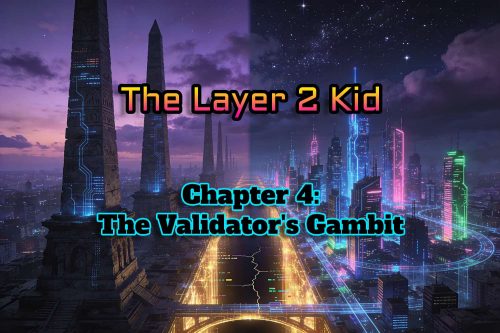
Chapter 4: The Validator’s Gambit
Chapter 5: Cross-Chain Contagion <<<<<< NEXT
Chapter 6: The Infinite Rollup
Chapter 7: Sovereignty on a Sidechain
Chapter 8: Burning the Bridge
Chapter 9: The Interoperability Pact
Chapter 10: Not a Chain, an Ecosystem
