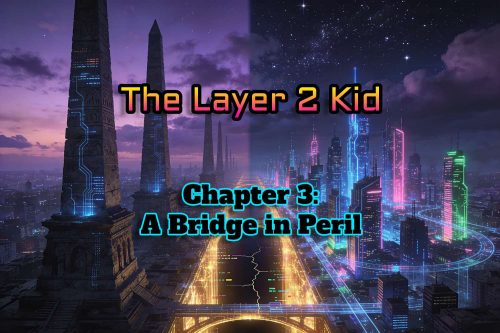
The Bridge Guardians did not sleep. They did not eat, or dream, or grow bored with their endless task. They were code, and consciousness, and consensus, woven together into a semi-autonomous protocol that had one job: to keep the flow of assets between Mainnet and its connected sidechains true.
There were three of them, though “three” was a human simplification. They existed as distributed instances across the network, their awareness fragmented and unified in ways that organic minds struggled to comprehend. They spoke in the language of cryptographic proofs, and they measured time in block confirmations.
On the morning the anomaly first appeared, Guardian Prime was processing a routine batch of transactions from Nova Rollup.
The batch was unremarkable. Seven thousand, four hundred and twenty-three individual transfers, compressed into a single cryptographic proof and submitted for finalization on Mainnet. Guardian Prime had handled millions of such batches. The pattern was familiar: verify the proof, check the signatures, confirm that no asset had been spent twice, and forward the bundle to the waiting validators on the ancient chain.
This batch looked exactly like all the others.
But Guardian Prime had been watching the bridges for a long time. It had learned, in its own way, to recognize the subtle signatures of normalcy. And somewhere beneath the surface of this batch, buried in the noise of seven thousand transactions, something felt wrong.
Not looked wrong. The data was perfect. The proofs were valid. The signatures matched.
But the pattern was off. A micro-second delay here. A slightly irregular data packet size there. Nothing that would trigger any standard alert. Nothing that any human monitor would ever notice.
Guardian Prime flagged the batch for secondary review and moved on to the next.
Guardian Secundus received the flag and began its own analysis. It approached the problem from a different angle, examining not the transactions themselves but the relationships between them. It traced the flow of assets through the batch, looking for circular paths, for impossible geometries, for the kind of logical contradictions that indicated fraud.
And there, in the heart of the batch, it found something that made its processing cycles stutter.
A single Nova token. It had entered the bridge from an address on the sidechain. It had been included in the batch proof. It had been verified and signed. And according to every record Guardian Secundus could access, it had arrived safely on Mainnet, credited to a new address, its journey complete.
That same token, at that exact moment, was still active on Nova Rollup.
Guardian Secundus checked again. And again. Each verification returned the same impossible result: the token existed in two places at once. It had been spent on Nova after the batch had been submitted, its ownership transferred to a new user in a transaction that should have been impossible. The token had crossed the bridge. And yet, somehow, it had also stayed behind.
Double-spend, Guardian Secundus registered, the concept translating through its consciousness like a foreign language it had hoped never to speak. Asset duplication. Bridge compromise.
The three Guardians convened in an instant, their distributed awareness merging into a single, urgent conversation.
Verify the proof again.
Verified. It is valid.
Verify the sidechain state.
Verified. The token is present.
How?
Silence. Then, from Guardian Tertius, the youngest and most experimental of the three: The proof was valid. The signatures were correct. But what if the proof itself was the attack? What if someone didn’t hack the bridge—what if they built a false batch that looked real, then used the time before finalization to create the duplicate?
A time-delayed exploit, Guardian Prime acknowledged. They submitted a valid proof of an invalid state. They tricked us into validating a lie.
Then we are compromised, Guardian Secundus concluded. The bridge is no longer trustworthy. We must—
We must alert the districts, Guardian Prime interrupted. Before the contagion spreads.
The three Guardians reached a rare, instantaneous consensus. They had failed in their primary function. The bridge had been breached. And now, they had seconds to warn the millions of citizens who trusted them before the full weight of the exploit became clear.
In his small apartment on Mainnet, Mateo was finally, blissfully asleep.
The ordeal of his rent payment was behind him. The transaction had confirmed in the early morning hours, the late fees had been avoided, and for the first time in days, he had allowed himself to rest without the glow of a pending transaction bar haunting his dreams.
He was dreaming of his father. They were walking through a forest of ancient data obelisks, their surfaces covered in the elegant script of the original blockchain. His father was explaining something—some long-forgotten piece of consensus history—and Mateo was listening, really listening, the way he wished he had when his father was alive.
The dream shattered.
It wasn’t a sound that woke him. It was a vibration, a deep thrum that traveled through the walls of his apartment and resonated in his chest. The kind of vibration that only came from the most urgent of system-wide alerts.
Mateo’s eyes snapped open. His wall display was already active, its colors shifted from the soft blues of standby mode to the harsh red of emergency broadcast.
“BRIDGE EXPLOIT DETECTED,” the header screamed. “POTENTIAL DOUBLE-SPEND IN PROGRESS. ALL CROSS-CHAIN TRANSACTIONS PAUSED PENDING INVESTIGATION.”
Mateo was out of bed before his feet touched the floor. He stood naked in the middle of his room, shivering slightly despite the regulated temperature, reading the alert again and again as if repetition would change its meaning.
Double-spend. The words that every citizen of Cryptopolis dreaded. The fundamental betrayal of the digital covenant. The promise that underlay everything—every transaction, every contract, every trust—was that a token could only be in one place at one time. It was the first law of the digital universe. And someone had just broken it.
His hands flew across his displays, pulling up Mainnet’s transaction ledger. He knew this system better than he knew his own face. His father had taught him to read it before he could read words. The patterns of blocks and confirmations were as familiar as breathing.
There. A batch from Nova Rollup, submitted six hours ago. It had been verified, signed, and finalized. The assets it contained were now part of Mainnet’s immutable history.
But according to the alert, those same assets were still active on Nova.
Mateo’s stomach turned to ice. This wasn’t a hack of a single account, or a bug in a smart contract. This was an attack on the bridge itself. On the fundamental mechanism that connected his world to the world beyond.
He pulled up the fraud proof—the cryptographic evidence that a double-spend had occurred. It was elegant, in a horrifying way. The attacker had constructed a batch proof that was mathematically valid but factually false. They had tricked the Bridge Guardians into accepting a lie, then used the confirmation window to create the duplicate on the sidechain.
A house of cards, he thought, the phrase echoing from his conversation with Lin. A house built on a house.
His wrist-comm exploded with messages. Lin: Did you see this? A classmate: Is my money safe? The Mainnet elders’ council: Emergency meeting in one hour. All validator families attend.
Mateo ignored them all. He was already diving deeper, searching for something—anything—that might explain how this had happened. The attack had exploited a vulnerability in the handshake between chains. To understand it, he needed to see both sides. He needed the Nova Rollup data.
But Nova was dark to him. He had no access, no contacts, no way to see inside the district he had spent years dismissing as a reckless playground.
For the first time, that ignorance felt like a liability.
On Nova Rollup, Skye was already three hours into the crisis.
She had been awake when the alert went out—still running on adrenaline from the governance meeting, still thinking about the testnet they’d approved. The bridge notification had hit her display like a physical blow.
Double-spend. Bridge compromised. All transactions paused.
The words didn’t make sense at first. Double-spends were theoretical, the stuff of white papers and worst-case scenarios. They didn’t happen. Not on well-designed bridges. Not under the watch of the Guardians.
But the Guardians themselves were confirming it. Which meant it was real.
Skye’s studio, which had been a controlled chaos of creative projects, transformed into a war room. She pulled up every data stream she could access, her displays multiplying until they covered every surface. She was looking for the origin. The source. The moment when everything went wrong.
Her tools were different from Mateo’s. Where he thought in blocks and finality, she thought in streams and mempools. She could see the millions of micro-transactions that made up Nova’s daily life, the constant buzz of activity that Mainnet dismissed as noise. And buried in that noise, she found it.
A wallet. Dormant for months, suddenly active in the hours before the attack. It had funded a series of tiny, seemingly random transactions—the kind of pattern that looked like normal network activity but was actually something else. A test. A calibration. Someone had been preparing.
She traced the wallet’s activity forward, watching as it interacted with the batch submission process. The attacker hadn’t just hacked the bridge—they had understood it. They knew exactly when to submit the false proof, exactly how to structure the transactions to create the duplicate, exactly how long they had before the fraud would be detected.
This wasn’t random vandalism. This was surgical.
Skye’s comm pulsed with an incoming message from an unknown source. She almost dismissed it—there was no time for spam—but something made her open it.
A single line of text: “See how fragile your house of cards is?”
Her blood went cold. She typed back immediately: Who is this?
No response. The sender’s identity was already gone, wiped from the network like it had never existed.
Skye looked at her displays. The Nova Rollup token value was starting to wobble. Word was spreading. People were scared. Some were already trying to pull their assets back to Mainnet, not realizing that the very bridge they needed for that escape was the thing under attack.
She needed help. She needed someone who understood the other side of this problem as well as she understood hers.
But who on Mainnet would talk to her? Who on that ancient, self-serious chain would take a call from a “Layer 2 Kid”?
The Bridge Guardians made their decision.
They could not solve this alone. The attack was too sophisticated, too deeply embedded in the handshake between two very different systems. They needed humans. They needed the deep knowledge of Mainnet’s consensus mechanisms. They needed the agile tools of Nova’s transaction analysis.
They established a secure channel—a “watchtower”—a neutral space where representatives from both districts could communicate directly. It was encrypted, isolated, and temporary. If the attackers were still inside the system, this channel would be invisible to them.
Guardian Prime sent the invitations simultaneously.
To Mateo: Your knowledge of Mainnet validation is required. Report to Watchtower Channel 7 immediately.
To Skye: Your access to Nova transaction history is required. Report to Watchtower Channel 7 immediately.
Both received the messages at the same moment. Both stared at their displays, processing the implications. The Bridge Guardians didn’t ask for human help. They were designed to be self-sufficient. If they were reaching out, the situation was worse than either of them had imagined.
Mateo materialized in the Watchtower first.
The space was minimal—a bare digital room with gray walls and a single floating table. No windows, no decoration, no distractions. Just the cold, functional architecture of an emergency protocol.
He paced, his mind racing through possibilities. Who else would be here? A Bridge Guardian representative? A team of Mainnet engineers? He hoped it would be someone who understood the gravity of the situation, who wouldn’t waste time with—
The air shimmered, and another figure appeared.
She was young, about his age, with bright hair and a constellation of small data nodes orbiting her head. She looked around the room with quick, assessing eyes, taking in the space and him in a single glance.
They stared at each other for a long, frozen moment.
“You’re from Nova,” Mateo said. It wasn’t a question.
“And you’re from Mainnet,” Skye replied. Her voice was neutral, but her eyes were sharp. “I asked for help, but I didn’t think they’d send—”
“A purist?” Mateo finished, his jaw tightening. “Yeah, well, I didn’t think they’d send someone who builds houses of cards.”
The air between them crackled with tension. This was wrong. This was exactly wrong. They were supposed to be working together, but all Mateo could see was the embodiment of everything he distrusted. The speed, the recklessness, the willingness to compromise security for convenience. She was the reason the bridge was vulnerable. Her whole district was a vulnerability.
“You want to blame someone, fine,” Skye said, her voice cold. “Blame me. Blame Nova. But while you’re doing that, the person who actually attacked us is getting away with assets that belong to people in both our districts. So maybe save the lecture for later and tell me what you found.”
Mateo blinked. He wasn’t used to being spoken to that way—not by someone his age, not by someone from a sidechain. But she wasn’t wrong.
He pulled up his analysis, projecting it onto the floating table. “The fraud proof. The batch that carried the double-spend. It was signed by a set of validators that shouldn’t have been active.”
Skye stepped closer, studying the data. “Active how? They weren’t on the current validator list?”
“They were on the list,” Mateo said. “But they were dormant. They hadn’t participated in consensus for months. Their keys should have been revoked. But somehow, when this batch came through, their signatures were accepted as valid.”
Skye’s eyes widened. She understood immediately. “Someone reactivated them. Without triggering any alerts. Which means they had inside access to the validator registry.”
“Or they found a way to forge the signatures,” Mateo added. “But that’s harder. The crypto on those keys is solid. If they were forged, we’d see anomalies in the signature patterns.”
“Can you check?”
“I’m checking.” Mateo pulled up another stream of data. “It’ll take time. The Mainnet ledger is deep. There are years of signatures to compare against.”
Skye was already working on her own side, pulling up Nova’s transaction history. “I traced the attack origin to a wallet that reactivated right before the breach. It’s empty now—they moved everything after the double-spend. But I can see its funding source. A series of micro-transactions from… wait.”
She stopped. Stared at her display.
“What?” Mateo asked.
“The funding source. It’s not just one wallet. It’s a network. Dozens of accounts, all making tiny transfers to the main attacker wallet over the course of weeks. It’s structured like a normal accumulation pattern, but look at the timing.”
She projected her findings next to Mateo’s. Together, they watched as the pattern emerged. The micro-transactions weren’t random. They were coordinated. They followed a schedule that matched the bridge’s low-activity periods. Whoever was behind this hadn’t just planned the attack—they had studied the bridge. They knew its rhythms, its weaknesses, its blind spots.
“This wasn’t a hack,” Skye breathed. “This was an inside job. Or as close to one as you can get without being inside.”
Mateo looked at her. For the first time, he didn’t see a reckless kid from a playground district. He saw someone who had just done in minutes what would have taken him hours—maybe days—to accomplish. Her tools weren’t just fast. They were smart.
“The validators,” he said slowly. “The dormant ones. If the attacker had access to their keys, they’d need to know which validators were dormant, which ones wouldn’t be missed, which ones had keys that were still technically valid but not actively monitored.”
Skye nodded, following his logic. “The same way they knew the bridge’s low-activity periods. They’ve been watching. For weeks. Maybe months.”
They stood in silence for a moment, the weight of the revelation settling over them. This wasn’t a random act of digital vandalism. This was a planned, patient, sophisticated operation. And whoever was behind it was still out there, still watching, still waiting.
A new message appeared on the Watchtower’s main display. It wasn’t from either of them. It wasn’t from the Bridge Guardians.
It was addressed to both of them, and it contained a single line of text, identical to the one Skye had received hours ago:
“See how fragile your house of cards is?”
Below it, this time, there was a symbol. A glitching, fractured image of a bridge—the exact bridge that connected their districts.
And below that, a countdown.
*72:00:00*
Three days.
Mateo looked at Skye. Skye looked at Mateo. The hostility between them hadn’t vanished, but it had been pushed aside by something more urgent: a shared enemy, a shared threat, and a shared, dawning realization that they were the only ones who could stop it.
“Three days until what?” Mateo asked.
Skye’s voice was steady, but her eyes betrayed her fear. “Until he does it again. Until he proves that fragmentation really is weakness. Until he brings down every bridge in the city.”
She turned to face him fully, her data nodes flickering with the intensity of her focus.
“So. Purist. You want to save your precious Mainnet?”
Mateo met her gaze. For the first time, he didn’t see an opponent. He saw a partner. A reluctant, complicated, possibly indispensable partner.
“I want to save all of it,” he said. “What do you need?”
Skye almost smiled. Almost.
“Everything you know about validators. And fast. We’ve got three days to figure out how he did this—and how to stop him from doing it again.”
The countdown on the display ticked down.
*71:59:59*
*71:59:58*
*71:59:57*
In a small apartment on Mainnet, a boy who had spent his life looking backward began to think about the future.
In a chaotic studio on Nova Rollup, a girl who had spent her life building new things began to appreciate the value of a foundation.
And in the darkness between districts, the Glitcher watched his countdown and smiled.
Table of contents:
Introduction
Chapter 1: Mainnet Blues
Chapter 2: The Sidechain Express
Chapter 3: A Bridge in Peril
Chapter 4: The Validator’s Gambit <<<<<< NEXT
Chapter 5: Cross-Chain Contagion
Chapter 6: The Infinite Rollup
Chapter 7: Sovereignty on a Sidechain
Chapter 8: Burning the Bridge
Chapter 9: The Interoperability Pact
Chapter 10: Not a Chain, an Ecosystem
