The confirmation bar on Mateo’s wall display had crawled to ninety-four percent.
He stared at it, willing it to move, the same way he used to will his little brother to hurry up and get out of the bathroom before school. It didn’t work then, and it wasn’t working now. The glowing blue bar, representing the progress of his latest transaction as it wormed its way through the labyrinthine consensus mechanisms of the Mainnet, remained stubbornly, infuriatingly still.
On the other side of the small, meticulously organized room, a soft chime announced the arrival of a new message. Mateo didn’t need to look. He knew what it was. His landlord’s automated system, now sending its third reminder. Rent Payment: Overdue. Please remit 1,200 Gas Tokens immediately to avoid late fees.
“Working on it,” Mateo muttered to the empty room, his eyes never leaving the display.
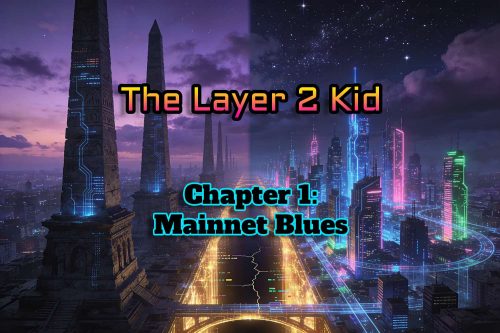
His apartment was a reflection of the district he lived in. The Mainnet district of Cryptopolis was the oldest part of the digital metropolis, the original settlement, the foundation upon which everything else was supposedly built. Its architecture was solid, monumental, and a little bit worn. The walls of Mateo’s apartment hummed with a low, constant vibration—the sound of computational finality, of truth being etched into the digital bedrock. Holographic schematics of ancient consensus algorithms decorated the walls: diagrams of Proof-of-Work chains, explanations of Byzantine Fault Tolerance, portraits of the original pseudonymous architects. To Mateo, these weren’t just dusty historical artifacts. They were scripture.
He flicked his wrist, expanding a smaller window next to the stalled transaction. It showed his account balance. Or rather, it showed what was left of it after he’d initiated the payment. The fee—the “Gas” required to bribe the network’s validators to process his request—had already been deducted. Forty-seven tokens, he thought with a familiar pang of frustration. Gone. Just to ask them to maybe look at my payment sometime this week.
The transaction bar hit ninety-six percent. Then stopped.
A small notification appeared beneath it: *Network congestion detected. Estimated completion: 2-4 hours.*
Mateo let out a long breath and ran a hand through his dark, unruly hair. Two to four more hours. He’d already been waiting six. He was a citizen in good standing, the son of a Validator, a boy who had been raised on stories of the Mainnet’s unshakeable integrity. It was the most secure, the most decentralized, the most true place in all of Cryptopolis. But truth, he was learning, came at a cost. And the cost was time, and time was money, and right now both were slipping through his fingers.
His wrist-comm pulsed with an incoming call. Lin’s face appeared in a small hologram, his expression a mix of sympathy and the kind of cheerful condescension that made Mateo’s jaw tighten.
“Still waiting, huh?” Lin asked, his voice tinny through the speaker.
Mateo gestured vaguely at the frozen display. “Ninety-six percent. It’s been there for an hour.”
Lin chuckled. He lived in a smaller, more modern district connected to the Mainnet, but not of it. “Dude. I told you. You have got to stop doing this to yourself. Just bridge some of your tokens over to a Layer-2. Pay your rent on Nova Rollup. It’d take like, two seconds. The fee would be a fraction of a token.”
Mateo felt a familiar prickle of irritation. “And have my rent payment secured by a playground? No, thanks.”
“It’s not a playground, it’s a rollup! It’s just as secure, it just batches the transactions and—”
“I know what it does, Lin.” Mateo’s voice was sharper than he intended. He softened it. “I know the theory. But it’s not the same. It’s a promise backed by a promise. On Mainnet, the proof is there. It’s in the stone. On those sidechains, it’s all… smoke and mirrors until it gets written back here. It’s reliant on a bridge.”
“And that bridge is solid,” Lin argued. “The Bridge Guardians have never had a major fault. You’re just being a purist.”
Purist. It was a word people used like an insult now. Like being careful, being principled, was a character flaw. “I’m being safe,” Mateo corrected him. “You know what happened in the Early Expansion? When people got caught up in the hype of the first sharded chains? The hacks, the double-spends, the… the chaos? My dad still has the logs. He shows them to me. A house built on a house is still just a house of cards.”
Lin sighed, the sound heavy with the weight of a thousand similar conversations. “Okay, Grandpa. Well, when your rent finally goes through in the year 2150, let me know. I’m heading to a new gaming district that just launched on Nova. They’ve got these physics-defying battle arenas… you can’t even tell the computation is happening off-chain. It’s seamless. You should see it.”
A new window popped up on Lin’s side of the call. It was a live feed from a public observation deck, one of those touristy spots that looked out over the city. But Lin had zoomed in on the distance, on the far-off glittering district of Nova Rollup. It was a blur of light and motion. Buildings didn’t just stand there; they morphed, shifted, and grew in real-time. Streams of data pulsed like neon blood through its translucent avenues. It looked like someone had taken the concept of a city and injected it with a hyperactive stimulant.
“That’s not a district,” Mateo said, unable to keep a note of wonder—or was it horror?—out of his voice. “That’s a carnival. It’s built for speed, not stability.”
“It’s built for people, Mateo. People who can’t afford to wait two days and pay a week’s wages just to buy a coffee.” Lin’s image flickered. “Look, I gotta go. My ride to the bridge is about to leave. Just… think about it, okay? You don’t have to live there. Just use it. Like a tool.”
The call ended, leaving Mateo alone with his frozen transaction and the afterimage of that frantic, flashing district. He looked back at his own window. The view from his apartment was of grand, ancient data obelisks, their surfaces etched with the immutable history of every transaction ever made. They were beautiful in their own way, like mountains. Solid. Eternal. But they were also dark, and quiet, and they cast long shadows.
He tried to focus on a school assignment—analyzing the security parameters of a new zero-knowledge proof protocol—but his mind kept wandering. He saw himself zipping through Nova Rollup, his rent paid in a blink, a coffee purchased with a casual wave. He imagined the feeling of that speed, that frictionless existence. Then he imagined the whole thing simply… vanishing. A glitch in the bridge, a corrupted batch, and all those instant coffees and seamless transactions becoming nothing more than corrupted data. A house of cards.
The transaction bar finally, finally moved to ninety-seven percent.
Mateo let out a humorless laugh. “Woo.”
He got up and paced the small room. His gaze fell on a physical photograph tucked into the corner of his main display—an old-fashioned print of his father, standing in front of one of the original Mainnet validator nodes. His father, a man who had dedicated his life to maintaining the chain’s integrity, who had taught Mateo that every block was a brick in the cathedral of truth. What would he think of Nova Rollup? Of this new generation that saw the Mainnet not as a sacred foundation, but as a slow, expensive settlement layer?
Mateo knew the answer. His father would see it as a dilution. A compromise. A betrayal of the original vision.
A low hum emanated from his wall display, a different frequency than the usual computational thrum. It was the sound of a city-wide alert. A news feed materialized, overlaying his transaction progress.
“…minor anomalies detected in cross-chain bridge traffic. The Bridge Guardians, the semi-autonomous protocol managing the flow of assets between Mainnet and all connected sidechains, have issued a statement. ‘We are observing unusual latency patterns. Users are advised that there may be slight delays in asset finalization. The integrity of all funds remains secure. We are investigating.'”
Mateo stopped pacing. He stared at the news feed. Unusual latency patterns. Anomalies. It was a small thing. A nothing-burger. They said the funds were secure.
He looked from the news alert, to the frozen image of Nova Rollup still lingering in his chat with Lin, and back to his own transaction, now stalled again at ninety-seven percent.
A cold, unfamiliar feeling settled in his stomach. It wasn’t satisfaction at being proven right. It wasn’t even fear for his own meager savings. It was something else. A premonition. A sense that the carefully constructed, multi-layered world he lived in—his solid Mainnet and Lin’s flashy carnival—was more fragile than anyone wanted to admit. The bridges that connected them weren’t just pathways. They were dependencies. And if the Bridge Guardians were worried, then maybe, just maybe, the house of cards wasn’t just the one Lin lived in.
Maybe the whole thing was.
His wrist-comm chimed. Another reminder from his landlord. He dismissed it.
The transaction bar finally, agonizingly, reached one hundred percent. A soft, final chime. Transaction Confirmed. Rent Payment Complete. Gas Fee Deducted: 52 Tokens.
He was safe. He was current. He was secure.
Mateo walked to his window and looked out at the real city, not the schematics on his wall. In the distance, beyond the dark, silent obelisks of Mainnet, the lights of Nova Rollup pulsed and danced, a frantic, brilliant beacon in the night. The shimmering beam of light that was the bridge connecting their worlds looked thin. Frail. Like a single thread holding two weights in balance.
For the first time in his life, Mateo didn’t feel proud of where he lived. He just felt tired. And as he watched the distant, flickering lights of the Layer-2 Kid’s domain, he felt a tiny, unwelcome flicker of his own.
Curiosity.
Table of contents:
Introduction
Chapter 1: Mainnet Blues
Chapter 2: The Sidechain Express <<<<<< NEXT
Chapter 3: A Bridge in Peril
Chapter 4: The Validator’s Gambit
Chapter 5: Cross-Chain Contagion
Chapter 6: The Infinite Rollup
Chapter 7: Sovereignty on a Sidechain
Chapter 8: Burning the Bridge
Chapter 9: The Interoperability Pact
Chapter 10: Not a Chain, an Ecosystem
