Skye woke to the sound of opportunity.
It wasn’t a noise, not really. It was a vibration in the air, a hum of activity that permeated every wall of her studio in the Nova Rollup district. Even with her eyes closed, she could feel it—the ceaseless pulse of transactions, the flicker of smart contracts executing, the constant, beautiful chaos of a million micro-economies coming to life. On Mainnet, they probably woke to the sound of a single, solemn chime announcing that a block had been finalized sometime during the night. Here, every second was a symphony.
She stretched, her arm knocking a floating holographic display that had been left hovering too close to her bed. It spun lazily, showing the overnight activity on a gaming platform she’d helped architect. Active users: 127,000. Transactions processed: 2.4 million. Total fees collected: 34 Nova Tokens.
Skye grinned. Thirty-four tokens. On Mainnet, two million transactions would have cost more than the entire district’s GDP. Here, it was the equivalent of pocket change, split a thousand ways among the validators who kept the rollup running. That was the magic. That was why she’d never, not once, regretted leaving the stuffy, self-important world of the foundational chain.
She swung her legs out of bed and landed in the middle of her workspace.
The studio was a reflection of everything Skye loved about Layer-2 life. It wasn’t large, but it was dense. Holographic displays layered over every available surface, showing real-time data streams, social feeds, the status of her various projects, and a constantly updating map of Nova Rollup itself. The walls, what little of them were visible, were covered with digital whiteboards filled with half-finished code,拓扑 diagrams of proposed network upgrades, and sticky notes with ideas scrawled in a dozen different colors. A small, physical plant sat on her desk—the only non-digital object in the room—somehow thriving despite the ambient electronic glow. She’d named it Genesis Block.
“Morning, Gen,” she said, giving it a quick spritz of water from a bottle on her desk. “Let’s see what we missed.”
She waved her hand, and the main display expanded. Her personal transaction log scrolled past at a speed that would have given any Mainnet citizen heart palpitations.
*06:32: Coffee purchase from “Brew Protocol” – 0.003 NOVA. Confirmed.*
*06:33: Tip to developer of “Ambient Beats” background music app – 0.001 NOVA. Confirmed.*
*06:34: Micro-royalty payment for digital art sale (previous day) – 2.5 NOVA. Confirmed.*
*06:35: Entry fee for “Neon Racer” daily tournament – 0.5 NOVA. Confirmed.*
*06:36: In-game purchase: neon paint job for racing pod – 0.1 NOVA. Confirmed.*
All of it, from coffee to car paint, settled in the time it took her to brush her teeth. The fees were invisible, measured in fractions of a cent. This was life in the express lane.
Skye grabbed a piece of synth-fruit from a bowl on her desk—another physical indulgence—and bit into it as she scanned the day’s headlines on the Nova Rollup community board. A new decentralized exchange was launching in the creative quarter. Someone was hosting a workshop on writing secure smart contracts for beginners. A group of artists was collectively minting a massive, collaborative mural, each pixel an NFT.
It was everything she loved. Access. Experimentation. Possibility.
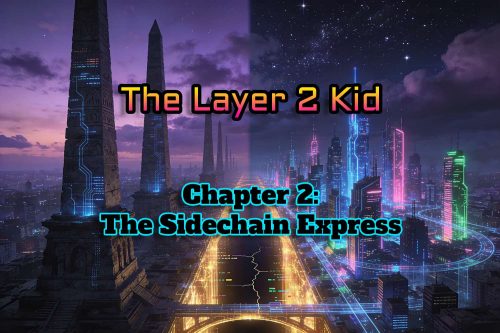
Her gaze drifted to a smaller window in the corner of her display, one that showed a live feed of the distant Mainnet district. Its ancient data obelisks stood dark and silent against the simulated sky, looking for all the world like a museum diorama of a dead civilization. She’d grown up hearing stories about Mainnet’s glorious past, its unshakeable security, its role as the ultimate source of truth. But she’d also seen the price of that truth. Her cousin had tried to launch a simple art project there last year. The gas fees had eaten his entire budget before the first image was even stored. He’d given up and moved to a different sidechain entirely.
Let them have their truth, Skye thought, not for the first time. We’ll take the future.
Her wrist-comm pulsed with a calendar alert. *Governance Forum: Weekly Community Meeting. Starts in 15 minutes. Topic: Proposed Experimentation with ZK-Rollup Variant #7.*
She groaned, finishing her fruit. The best part of Nova—the freedom to innovate—also came with the worst part: the constant need to govern that innovation. On Mainnet, things moved at a glacial pace because change was hard, deliberate, and required consensus from a small, powerful group of validators. Here, anyone could propose anything, which meant everyone did propose anything, and it fell to people like Skye to help sort the brilliant ideas from the catastrophically bad ones.
She flicked her wrist, accepting the meeting, and began the walk to the virtual town square. As she moved through the digital corridors of her building, she passed neighbors engaged in their own morning rituals. A woman was haggling with an AI over the price of a data storage plan. A kid no older than twelve was live-streaming a tutorial on how to build a basic trading bot. An elderly man who had moved to Nova specifically because his pension went further here was tending a virtual garden that existed across three different chains, its ownership verified by a cross-chain protocol Skye had helped debug.
This was her community. Messy, chaotic, and absolutely alive.
The Nova Rollup virtual town square was, at any given time, a controlled disaster.
Today, several hundred avatars were gathered in a sprawling digital amphitheater. Some were detailed, personalized representations of their users. Others were simple icons, placeholders for people who just wanted to listen. A few were entirely abstract—glowing cubes, swirling fractal patterns, or in one case, a floating slice of pizza. The topic at the top of the space, rendered in bright, urgent letters, read: *Should we adopt ZK-Rollup Variant #7?*
Skye materialized in her usual spot near the front, her avatar a stylized version of herself with brighter hair and a constellation of small data nodes orbiting her head. She’d earned those nodes—they represented successful protocols she’d helped launch or secure. In this world, your reputation was written on your skin.
The debate was already heated.
“I’m telling you, the throughput increase alone is worth it!” A tall, energetic avatar representing a developer named Kai was pacing the virtual stage. “We’re talking fifty percent more transactions per second. Fifty percent! Do you know what that means for our gaming districts? For our micro-payment economy?”
“It means fifty percent more transactions we have to verify,” countered a more conservative voice, an older woman named Vera whose avatar was a simple, solid sphere. “And this variant hasn’t been battle-tested. The proof generation is more efficient, sure, but the underlying math has a theoretical vulnerability. It’s tiny, but it’s there. If someone found a way to exploit it…”
“Then we’d patch it!” Kai argued. “That’s how progress works! We can’t be paralyzed by fear of theoretical vulnerabilities. Mainnet has been paralyzed by that for a decade. Look where it got them. They’re a museum.”
A murmur rippled through the crowd. The word “Mainnet” was a complicated one here. It was the foundation they all depended on, the ultimate settlement layer that gave their fast, cheap transactions their long-term security. But it was also the enemy of everything they stood for—slow, expensive, and resistant to change.
Skye felt the weight of dozens of avatars glancing in her direction. She wasn’t an official leader of Nova Rollup. There was no such thing. But she was one of its most visible and respected builders. When she spoke, people listened. And right now, they were waiting for her to take a side.
She raised a hand, and the debate floor quieted.
“Kai’s not wrong about the throughput,” she began, her voice calm and measured. “We built Nova on the promise of speed and accessibility. If we stop pushing for more, we stop being what we are.”
Kai beamed. Vera’s sphere dimmed slightly.
“But,” Skye continued, and the amphitheater went absolutely silent, “Vera’s not wrong about the vulnerability. It’s tiny, but it exists. And here’s the thing about tiny vulnerabilities on a Layer-2: they’re not just our problem.”
She expanded a small display, showing a diagram of how Nova Rollup settled its transactions onto Mainnet. “Everything we do here gets bundled up, compressed into a proof, and sent across the bridge to be finalized on Mainnet. That’s our deal. That’s our security. We get speed, they get finality. But if there’s a flaw in how we generate those proofs—if someone could trick our system into generating a false proof—then it’s not just our economy that collapses. It’s the bridge’s integrity. And if the bridge’s integrity fails…”
She let the thought hang. She didn’t need to finish it. Everyone in that amphitheater knew what happened when trust in a bridge failed. The entire connected ecosystem trembled.
“So what do you propose?” Kai asked, his energy deflated but not defeated. “We never try anything new?”
“I propose we test it,” Skye said. “Not on the main Nova network. We spin up a separate testnet, a sandbox version of our district. We let Variant #7 run there for a month. We simulate high traffic. We try to break it. And if it holds, then we bring it to a vote for the main chain.”
A new murmur rippled through the crowd, but this one was different. It was approval. Consensus. The brilliant thing about Nova wasn’t just its speed—it was its flexibility. They could try things here without breaking everything. On Mainnet, an experiment that size would take years of planning and a fortune in fees. Here, they could spin it up in an afternoon.
The vote was called. The proposal to create a testnet for Variant #7 passed overwhelmingly. Kai approached Skye after the meeting dissolved, his avatar’s expression a mix of frustration and respect.
“You’re no fun,” he said, but he was smiling. “You know that, right?”
“I’m plenty of fun,” Skye replied. “I just like having a district to go home to at the end of the day.”
As the virtual amphitheater emptied, Skye lingered, watching the stragglers. Her wrist-comm pulsed with a new alert. It wasn’t a calendar reminder this time. It was a system notification, and the icon attached to it made her stomach tighten slightly.
Bridge Guardian Status Update: Unusual latency detected on Mainnet-Nova route. Asset finalization may be delayed. All funds remain secure. Monitoring ongoing.
She read the message twice. Unusual latency. That could mean anything. Network congestion on Mainnet. A backlog of transactions. The digital equivalent of traffic. But the Bridge Guardians didn’t send out alerts for routine congestion. They sent them for anomalies. For things they didn’t fully understand.
Skye looked up from her comm, her gaze drifting to the edge of the virtual square where a window showed the real-time view from Nova’s highest point. In the distance, the ancient obelisks of Mainnet stood silent and dark. The shimmering beam of the bridge connected them, pulsing with the flow of data and assets. From here, it looked steady. Normal.
But the alert on her wrist said otherwise.
She thought about the meeting she’d just mediated, the careful balance between innovation and security. She thought about the testnet they’d just approved, a sandbox where they could experiment safely. And she thought about the bridge, that fragile thread connecting her fast, chaotic district to the slow, certain foundation it depended on.
For the first time in a long time, Skye felt a flicker of something she didn’t often experience.
Uncertainty.
Later that evening, Skye sat on the rooftop garden of her building, a quiet perch that overlooked the endless construction of Nova Rollup. The district was never finished. New buildings rose daily, new protocols launched hourly, new communities formed in the space between heartbeats. It was exhausting and exhilarating in equal measure.
Genesis Block sat beside her in a small pot, its green leaves a stark contrast to the neon-drenched city below.
“You know what the problem is, Gen?” she said to the plant, which offered no opinion. “Mainnet thinks we’re reckless. And sometimes, I wonder if they’re right.”
She thought about the bridge alert. Still no update. The Bridge Guardians had gone silent, which was either a good sign—meaning the anomaly had resolved—or a bad sign—meaning they were still trying to figure out what had happened. In Skye’s experience, silence from security protocols was rarely a reason to relax.
She looked toward the distant Mainnet. From here, with the lights of her own district reflecting off the simulated atmosphere, it was hard to see the ancient obelisks clearly. They were just shapes in the darkness, reminders of a world that moved at a different pace.
A world she’d left behind. A world she still, in some complicated way, depended on.
“They’re not coming to save us if something goes wrong,” she murmured to Genesis Block. “They’d probably just cut the bridge and let us float away. ‘Problem solved.'”
The plant rustled slightly in a breeze she couldn’t feel.
Skye pulled up the bridge status again. Still no update. She expanded her view, looking at the broader ecosystem. Other sidechains, other Layer-2s, all connected by their own bridges to the same ancient Mainnet. A whole archipelago of districts, each with its own culture, its own rules, its own strengths and weaknesses.
And all of them linked by threads that, right now, felt a little too fragile for comfort.
Her wrist-comm pulsed one final time before she headed inside. A news alert, this time from a city-wide feed.
“Bridge Guardians confirm they are investigating ‘minor anomalies’ in cross-chain traffic. Spokesperson emphasizes that all funds remain secure and that users should experience no disruption. ‘This is a routine investigation,’ the statement reads. ‘There is no cause for alarm.'”
Skye stared at the message for a long moment. No cause for alarm. That was exactly what someone would say if they wanted to prevent panic.
She looked at Genesis Block. She looked at the glittering, chaotic, beautiful district below her. She looked at the distant, silent Mainnet.
And for just a moment, she allowed herself to wonder: what would happen if the bridge didn’t hold?
Then she shook off the thought, picked up her plant, and headed inside. Tomorrow, there would be code to write, communities to nurture, and a testnet to launch. There was no time for worrying about threads that had held for years.
But as she fell asleep that night, to the familiar hum of a million transactions processing around her, the image of that fragile beam of light lingered at the edge of her dreams. A connection. A dependency. A thread.
And somewhere in the darkness between districts, something was pulling on it.
Table of contents:
Introduction
Chapter 1: Mainnet Blues
Chapter 2: The Sidechain Express
Chapter 3: A Bridge in Peril <<<<<< NEXT
Chapter 4: The Validator’s Gambit
Chapter 5: Cross-Chain Contagion
Chapter 6: The Infinite Rollup
Chapter 7: Sovereignty on a Sidechain
Chapter 8: Burning the Bridge
Chapter 9: The Interoperability Pact
Chapter 10: Not a Chain, an Ecosystem
